
Unchosen Beliefs
Beyond Cognitive Intentions into deep-rooted emotional belief hierarchies


The intention is to take a sledgehammer to the current paradigm of belief systems and smash it into pieces. I have to acknowledge the paradoxical irony at play here that propositions rarely change beliefs. This should be obvious, that even when all the evidence (or facts point towards the opposite, people still “desperately” cling to their beliefs. This is actually the central premise of this essay, that is, beliefs (or rather belief states) are predominantly based in emotion. Or rather, they are emotional first, and cognitive second. I’ll give this article the treatment of a light version of a scientific paper. Before I address the premise statement of this entire thing, I want to do a mission statement instead. What I’d like to achieve with the writing is a logical and coherent framework that guides you through the layers of the neuroscientific concepts.
That also means that I am threading a balance between making it accessible enough and not watering down the significance, scope and complexity of the material. In my opinion, understanding the depth of these concepts (as it relates to beliefs), is the most beneficial when it comes to having high predictive viability and robustness. Which, in the end, is kind of the point of beliefs, to predict happenings internally and externally, with high precision (in the psychological sense, not the Free Energy Principle sense), so that models align more closely with the world. The premise statement might sound or read overwhelming, however, the point of this article is to walk you through it, as if you are new to the material. As far as sentence structure goes, it’s innately conversational since it matches my style when I coach people.
The premise statement:
Beliefs as hierarchical, preconscious affective priors: embodied predictions weighted by hedonic valence, shaped by evolutionary constraints, critical periods, and environmental interactions. They aren’t freely “chosen”, hence the title Unchosen Beliefs, rather they’re emergent from allostatic processes, resistant to superficial cognitive overrides, and updated only through experiential, bottom-up reweighting.
If you don’t know what any of this means, you will by the end of this. For this essay, I’ve opted for a different style to make it a bit more engaging. Instead of classic Hellenic philosophy, since I usually write a Platonic-Socratic style dialogue myself, I’m going to take you through the material as if you were a military recruit who signed up for a special forces detachment.
In a way, understanding the premise we are about to explore is also one of the greatest bullshit detectors imaginable. We’re in a maelstrom of slop information, and in a place of extreme levels of socio-cultural-political-religious extremes of gaslighting and social engineering. There is an intention behind engineering your behavior, capturing your attention, priming and stimulating the negative affective systems (more on this later). If desperate times call for desperate measures, then neuroscientifically engineered warfare needs neuroscientifically grounded shielding. If you buy into the premise that we are in a spiritual war, meaning this war over your affective drives, beliefs and behaviors, it stands to reason that you need to be trained properly to be a soldier in this war. True to the premise of this entire article, instead of teaching you to be a soldier, I am trying to train you to be the equivalent of the special forces. A special forces operator of neuropsychology, a deadly weapon against the parasitization of our identity and drives. You are now a recruit of the Cognitive Integrity Operations Detachment (CIOD). You made it to the big leagues, congrats, kid. Now let’s orient you.

This essay will guide you through the required areas of competency, called modules. Survive them all, and you are a certified operator in the CIOD.
Module I: Terrain & Architecture
Understanding the battlefield.
Module II: Regulatory Systems
Why beliefs exist at all.
Module III: Information Degradation
Why truth rarely survives ascent.
Module IV: Priors & Reweighting Transformative Windows
When belief change is actually possible, and the rare states where hierarchy collapses.
Module V: Biological Constraints
Why belief change is not “just mindset.”
Module VI: The Enemy And Their Weapons
Know who you are up against and how they fight.
Module VII: Integration
Wisdom instead of control
Summary
Conclusion
Now you have an idea of what is coming, let’s commence your training. Only the toughest make it through. So I hope you brought your lucky socks.
MODULE PIPELINE INITIATION
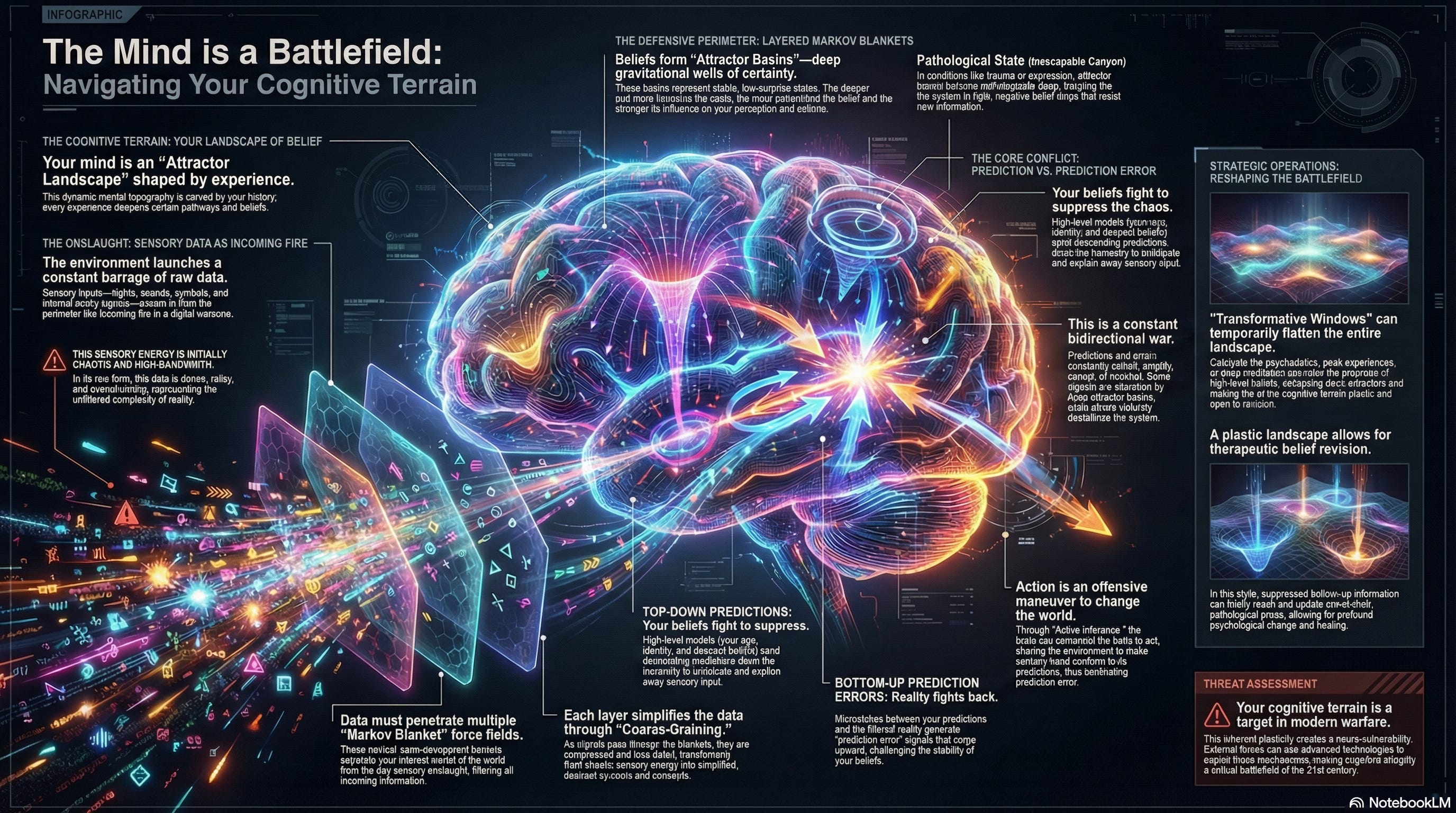
Module I: Terrain & Architecture
There are many attack vectors, as seen in the paper, The war inside your mind: unprotected brain battlefields and neuro-vulnerability, we’re going to focus on the neuro-vulnerability of beliefs for this article. As such, we are getting a lay of the land here. To understand exactly how the battlefield looks. The first element we need to explore is how models are made. For this, we will rely heavily on the active inference framework and the free energy principle (FEP) conceptualized by Karl Friston.
So what is a generative model? Effectively, it is a model that generates predictions about the external and internal world. To clarify: A generative model is an internal simulation that continuously generates predictions about sensory causes and the consequences of action. Most of it is based on survival, and another part on exploration vs exploitation of resources. Put another way: survival is achieved through inferences about the causes of sensations and about how to optimally act in order to maintain preferred states (the latter we will tackle later). We have this in common with all living beings. These generative models are preconscious, subconscious, and partially unconscious.
The idea is that these models attempt to minimize surprise, called free energy, over time, so we can stay in preferred states and reduce uncertainty. They form the priors, the initial datasets of information around which data self organizes or structure. This formation of information towards which things keep gravitating or being pulled towards is called an attractor state. Since we have critical windows of development, and certain experiences that happen within those developments, and experience carves a landscape of attractors, an attractor landscape that is supposed to help us survive. Think of the attractor landscape like valleys in a landscape, the system “rolls” into familiar, low-surprise attractors shaped by past threats/rewards. This will be expanded as we move through this article.
Surviving depends on the organism’s ability to maintain homeostasis, an “optimal” functioning of diverse systems, but mainly the body’s energy system and metabolism. Allostasis is how the organism responds to experiences that throw its internal equilibrium of states off. Which is obviously connected to both preferred states and survival. Thus, allostasis would determine the adaptability and, in a certain sense, resilience at the core of how all these systems function in tandem. That means that generative models also have to monitor what happens between the different systems, such as the arousal system and the affective system. Which is what the paper Arousal coherence, uncertainty, and well-being an active inference account states: “Put simply, we will suggest that when subjectively reported affective arousal and autonomic arousal (e.g. heart rate and pupil dilation) correlate positively over time (arousal coherence), the organism is more accurately tracking changes in its uncertainty, at multiple levels of interoceptive and affective processing, impacting its capacity to appropriately adapt to change, and to be well”
There are boundaries between these different levels of organization, called Markov Blankets. Effectively, a Markov Blanket is the separation that exists between two states, like an internal state and an external state, so the one is only influenced by the other through what is happening signals wise at the boundary. This happens as statistical boundaries and as actual boundaries, as seen in the cell membrane, which has sensors and receptors with which molecules can bind, and then either be signaled as a needed response on the other side of the membrane, or that channels open so molecules can be let through. In the computational sense, a Markov Blanket separates sensory states and internal states from action states.
Put more clearly, sensory states would be inputs from the environment/internal layers. Active states are the outputs and actions influencing the world. And internal states are hidden inferences and predictions. As we go up in the hierarchy of brain architecture and communication, there exist these Markov blankets to make sure the appropriate information reaches the higher levels. A lot of arousal state, or biological sensations, like blood pressure and the gastric basal rhythm, aren’t communicated. This is what they call coarse-graining, which is a loss of information for the sake of getting a general status of what is happening in the lower levels (affective and arousal). As such, there are degrees of separation between your cognition, or maybe more aptly described as conscious awareness, and meta cognition, and your lower/deeper levels, like affect and all the other biological processes that happen below awareness.
It’s important to understand that these models are looking for predictive validity, and thus are looking for a balance between clarity and efficiency, or accuracy and complexity (Tamas Spisak, Karl Friston, 2025). In this way, low complexity would be a soft attractor state with low precision, in which it has overly generalized priors that can’t distinguish nuances, which can be seen as “underfitting”. In contrast, High complexity would be “accuracy pumping” or “overfitting” to the data, exactly matching the data, which would be high precision (or high confidence that the model aligns with what happens in the world in terms of predictions). Then there is balanced complexity, which could be considered an optimal grip on reality. a state/model where both recognition and generalization are high, crucial for efficient representation and adaptability. A more appropriate way of putting it might be that the system handles complexity without collapse or explosion, hence balanced, and it can make predictions without getting stuck, which is a key feature. So that leads us to, what is driving these models in the first place? These drivers would be the emotional forces prioritizing survival and reward, which are rooted in affect, hedonic valence, and preferences. That’s where we’re headed next. You made it through module one, soldier and are cleared for module 2.
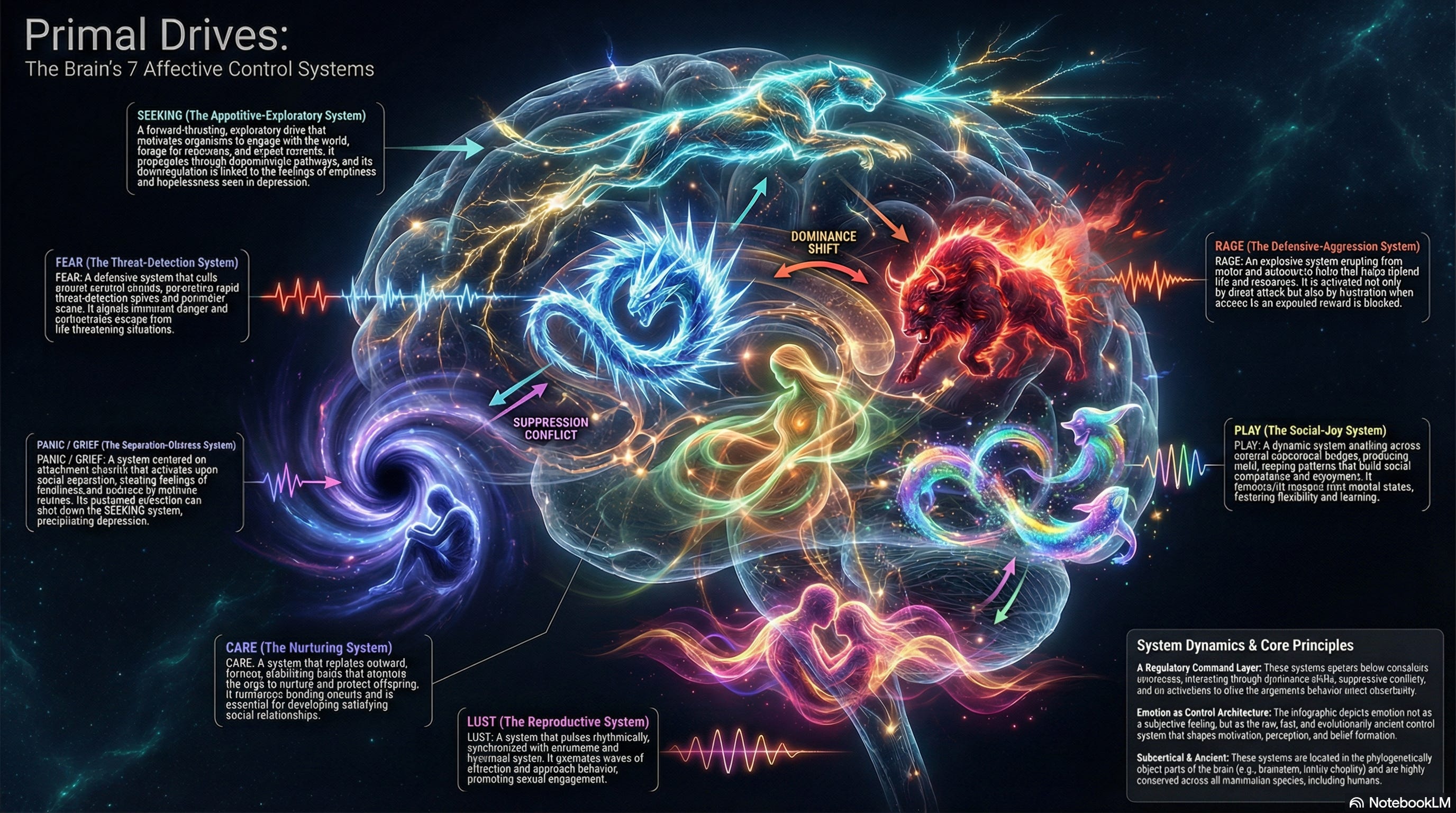
Module II: Regulatory Systems
The mission brief here is exploring why beliefs exist at all. As we saw in Module 1, the primary function of belief states is affording survival by having fitting predictions about what the external world provides and the internal needs. That’s why I started with generative models and how they are preconscious. The first aspect to explore is the preconscious part, from bacteria to humans and everything in between, that has these generative models. If these capacities weren’t preconscious, we could never survive, since at the instinctual level, there is a “knowledge” of how to couple to the environment to survive. Our children are uniquely vulnerable in that preconscious state, which is where affect comes into play. Affect is the raw primary feeling “tone” before differentiation. Solms considers this to be generated by homeostatic/allostatic error signals, effectively telling us if something is good for us or bad for us, right in that moment.
Panksepp calls it the Primary Process Affects. Affect has a quality, intensity, and direction. The quality of affect is what we consider hedonics, in terms of what type of feeling it is. Meaning, how good or bad it feels, which is termed hedonic tone. Effectively, it is the opponent processing between pleasure and displeasure, rewarding and punishing, and relief and distress. In terms of prediction error, Solms has outlined that hedonics reflects the success or failure of allostatic regulation. Where pleasure would result in error reduction. And unpleasure would result in error escalation. Let’s take a moment to pause here for the sake of letting that sink in. Because this is going to be an integral part of the communication that occurs between these lower-order levels of the neural architecture (where affect is generated) and the higher orders where our meta-cognition “resides”.
That leads us to direction, which is termed valence. Which tells us what to do about affect and its hedonics. Positive valence would lead to approach, engaging, and preferably maintaining “it”. On the other end, we have negative valence, which would lead to withdrawal, avoidance, and course correction. Even bacteria exhibit this approach - avoid dynamics, as it can distinguish what will benefit or harm it (between nutrients and toxins). It makes sense that what is deemed pleasurable is rewarding and that we “approach” it and try to get more of it. Since again, it signals those homeostatic survival systems that we are on the right track. Arousal would be the intensity of the affect, which would change attention or “need” to attend to this signal (prediction error). Think about it, the closer this gets to our survival, the more intense affect gets.
These concepts lay the groundwork for Panksepp’s 7 emotional systems. In this framework, emotion is affect + perception + learning + context + action tendency. For Panksepp, that meant these 7 systems, which he found across mammalian species and considered affective generators. I’ve taken the explanations from a brilliant paper by Panksepp and Christian Montag: Primary Emotional Systems and Personality: An Evolutionary Perspective.
The 7 systems represented as:
SEEKING → This is our general purpose appetitive exploratory-investigatory system that is essential for acquiring all the environmental resources needed for survival and propagation (positively valenced exploratory affect)
FEAR → Activation of this system signals danger and helps us escape diverse, dangerous, life-threatening situations, and thus negatively valenced threat affects.
RAGE/ANGER → This system helps us defend our lives and other resources, including territory It also activates with frustration when access to expected reward or opportunities is thwarted, negatively valenced frustration/violation affect
PANIC/GRIEF/SADNESS → This system is activated in situations of separation distress, with those feelings driving us to seek reunion. (negatively valenced separation distress)
CARE →When this circuit is activated, humans as well as other animals feel an urge to nurture and protect their offspring, positively valenced nurturance
PLAY → Is about building social competence and enjoyment (positively valenced social joy)
LUST → promotes sexual engagements, in case you didn’t guess. (positively valenced reproductive motivation)
When you think about it, this is how children learn precociously and subconsciously. They’re going off affect and the 7 emotional systems built on top of it. To be precise, they go off affect first, and as they enter certain developmental phases, these emotional systems become more pronounced. The preferences are already baked into the system and become enforced in these critical windows where attachment is the main determining parameter of, well, everything else that is built there. This is where the majority of the priors will be created. Most studies on childhood trauma show how adverse life experiences drive such detrimental consequences. We need attachment to survive and thrive. Which is why the PANIC/GRIEF system is there in the first place, to reestablish reunion with our means to survive, our mother (initially).
Let’s emphasize just how sensitive this period is. A baby is literally defenseless and incapable of surviving on its own. Adverse experiences don’t have to be acute trauma events, it can be chronic neglect, emotional abandonment, or different forms of punishment. The more these “insults” or injuries to the attachment stack, the heavier these priors become, as this is the most plastic our attractor landscape would be. The higher the arousal induced by the event, the more acute the learning of the model, and the deeper this attractor will form, and thus be a heavy prior. This sets the hierarchy of beliefs (or belief states) as they are initially deeply emotionally tuned.
Counter to what some perceptions or paradigms might perpetuate, belief isn’t a singular thing or model. It is a hierarchy, just like you have a hierarchy of physiological needs that the body will rotate through with whichever need is highest, we can see the same in those affect-rooted beliefs. Once there are affective and emotional perturbations, this cascade of cycling through the hierarchy chain begins. Which also illustrates why “triggers” are called as such. Not only do they trigger a cascade in the hierarchy, but they speak directly to those affective priors in the deepest level, the core of our being. Which is where our main vulnerabilities lie, especially when these are directly tied to our survival, as we’ve seen. Since affect and its emotions are our internal radar for what would be safe for us, or threaten our survival. Hence, the more significant the prior in weight, as an attractor, the more closely it is tied to our survival, and the higher the arousal (intensity) we experience when we encounter a trigger.
This trigger can be an actual threat to survival, or a perceptual and conceptual one. Whatever threatens our sense of self, perceptually and conceptually, would be classified as a threat to our existence or survival, since that sense of self-coherence is tied so deeply to our desire to survive. Identity is the central axis, or axis mundi, as a model upon which reality revolves. Such is the model that enables us to distinguish self from non-self, a key feature of the Markov Blanket, instantiated here by the boundary of our body, but also as a gauge and compass of what is good for us to begin with, in terms of what facilitates survival and as an extension of that, what would make us thrive.
This sets the stage for our ability to differentiate and discriminate what is right or wrong for us, across layers or levels of our biology and psychology. This requires integration, alignment, and coherence between the higher-order layers and the lower-order layers and their informational flow. The next module will cover informational flow and what “data sets”, sets of information, you are working with on a fundamental level. The importance of which can be summed up in a quote from Karl Firston: “You don’t have a model of your environment, you are a model of your environment”. As any good soldier would know, communication is key to relating information. So let’s explore how this looks between layers, and you and reality.
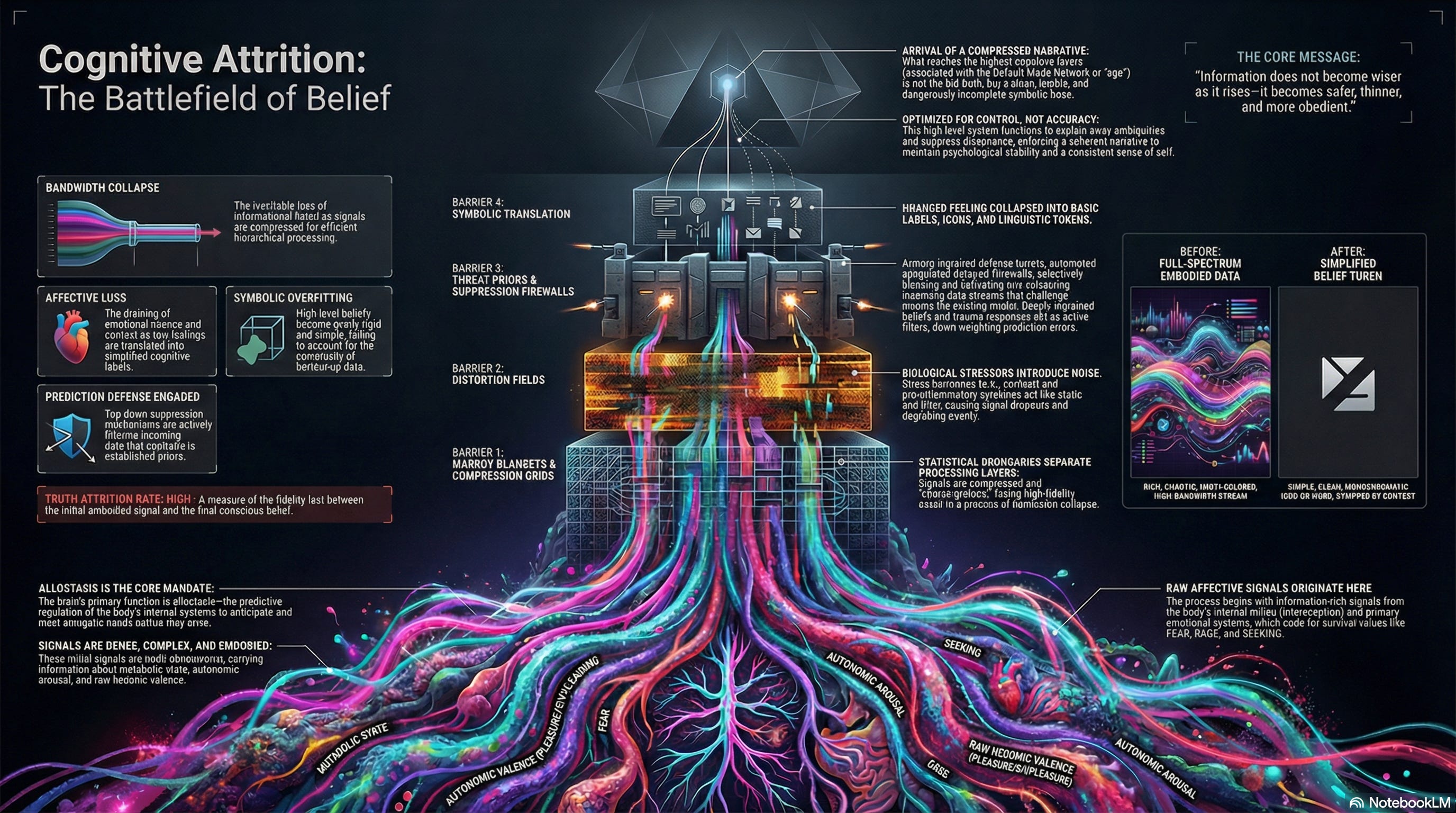
Module III: Information Degradation
There’s a saying, “truth is the first casualty of war”, which is pretty poetic and fitting. Truth in this case relates to the confidence (precision) in the predictions of those generative models. We know the external world can get noisy, literally. This principle extends to the internal world, inflammation, oxidative stress, and other stressors like depletion or deficits can create noise in the system. Outside of noise, if we return to the modes of communication between layers and their boundaries, certain signals never make it through, even when they are important. As we discussed in the neural architecture, you have lower-order layers and higher-order layers, all with their own functions and an “information preference”, the information that is relevant to that layer at that very moment. Poor interoception and arousal coherence, that is, arousal and affective systems information matching, contributes significantly to a considerable mismatch of information between higher-order levels and lower-order levels.
To go one step deeper, our affective priors are also information, with their heaviest attractor states in our attractor landscape. Which is where the real crux of the matter lies when it comes to difficulties in changing any aspect of our psychology, personality, identity, and behaviors. It also speaks to why “knowing better” doesn’t translate to doing (acting) better, especially when it is trauma-informed with its heavy attractor states. Very often, many of these belief states are merged with our sense of identity, and as such, belief change feels like an ontological threat (feels like ego death or existential unraveling). ESPECIALLY when it threatens our sense of self and our perceived sense of survival. Identity is formed on top of everything else, but since it exists at that high order of the hierarchy, it has a loss of information, and thus blindspot. Additionally, when identity formation (individuation and personalization/personhood) hasn’t taken place properly during those critical windows in childhood, there will be flawed co-identifications precisely because of those priors functioning as belief states.
These represent all those experiences that paved the way for your models of the world. When your personality has been suppressed, and your affective drives, you never really got to be you. The outcome of this is often called masks or roles, perhaps even the false self, in the modern sense of the word ego, a part of it can be found here. The ego is really your sense of self, instead of being “full of yourself” as the modern application typically suggests. To return to the point, there is a distance between the core you, or the true self if you will, based on all those hedonics and valence driven by affect, and the identity complex or construct that has been formed and shaped primarily by your parents. That sense of self then gets constructed upon what is, or rather was, functional to survive, in terms of the affect, hedonics and valence that was accepted and stimulated, which led to CARE (attention, nurturing, selection, validation, acceptance). The kicker is, even when CARE is absent, attention is better than no attention, which typically means negative attention, often expressed as punishment with its different shades of abuse.
Take a moment to let the implications of this sink in and reflect or retrospect on what that means for you. This is why I started the exploration with the preconscious -> subconscious -> unconscious hierarchy. Unconscious, in this sense, means what is happening, or rather, exists below your awareness. And this isn’t binary, it exists on a continuum. Some people have some sense of awareness or memories and can get a glimpse that something else is either playing a part in this or calling the shots. The evidence of that hierarchy is usually not found in your cognition or metacognition, although, of course, it will influence and impact it significantly. Rather, it is in your behaviors, your emotions, and your patterns. Why you respond the way you do to what, what makes you feel a particular way, why you keep making the same mistakes even though you “know better”.
Meta-cognition and awareness are necessary but insufficient. Those core affective drivers, the 7 emotional systems, and how they are connected to your attractor landscape and its priors, those guys are really calling the shots. The cortex, and its identity structure, is there to inhibit a lot of impulses and sensations for the sake of functionality and survivability, but that’s why it is both subject and sensitive to being overridden, no matter how smart, enlightened, or grounded you think you are. This is “by design”, meaning it is an adaptive function for the sake of survival. If the arousal, the intensity of the affect was high enough, you NEED to attend and respond to it. As many will understand, the issues happen when the signaling and systems that are supposed to balance this are fried and have been altered, in an adaptive sense to survive the circumstances, but those adaptations neurologically stay in place even as the circumstances have changed.
A good representation of this is the alterations and adaptations that happen in the amygdala, dealing with salience tagging and threat detection, the HPA axis, the main stress axis of the brain, the orbital frontal cortex, dealing with valuations and salience, and the many other layers and systems that change with it, leading to overactivation of certain parts, and under activation of others, and profound changes in neurotransmitter setpoints, and even genetic changes.
If you think that this is a lot, just reading it, imagine how much more of it is happening “underneath the surface” of your conscious awareness. The cortical “adjustments” in silencing information from the bottom up are a very clever mechanism to enhance survival. It is typically expressed as generalization, rationalization, minimization, and active (and obviously) suppression (avoiding the “triggers”). Calling these out generally falls under the “coping” and mental gymnastics category, which in both cases makes sense. You need to cope, and compensate for all those signals which are alarm bells going off constantly (numbing, drugs, etc) as it would drive anyone nuts, and the mental gymnastics are an attempt to avoid the gaping maw of the deepest valleys of these attractor states, those bottomless emotional pits. Avoidance is a “good” (functional) strategy to be able to keep moving forward. Or in a survival metaphor, to keep moving until you find a safe place to heal and recover.
Nowadays, though, there is very little pause or returning to a safe place to feel and heal. Rather, in the demands, pressures, and speed at which the social matrix operates, it is always something keeping you from addressing the core issues, and thus, you are forced to move on, or decide to move on. However, moving on is not letting go, because letting go relies on the premise that those priors are addressed and CHANGED. If I got paid for the number of times I’ve heard “I’ve let it go” when both their behavior and their emotional states don’t reflect anything of the sort, I would have raked in billions. People conflate and confuse the two. You can’t let go if the attractor states aren’t altered and the priors haven’t changed. This is why trauma, with its heavy affective priors form the base of a failure to update models. The model doesn’t change until the priors are changed so that new or other information can flow through when the attractor landscape has been collapsed.
Those layers and their information flow, represented by the Markov Blankets, is why this is reflected in the principle of the nested mind and nested consciousness in general (more on this in The Intuitive Self), since we’re not accessing each and every layer with our cognition. Which also speaks to why, as we’ve seen, some facts just don’t change our minds, but most importantly, don’t change our feelings, especially when those belief states have such significant attractor states. So “I’ll believe it when I see it” is more like “I’ll believe it when I feel it”. The problem has been outlined at an appropriate level. Now it’s a question of what we will do about it. We “all” know Change isn’t impossible, but what does it require?. What opens those transformative windows? That’s next in Module 4, as that’s the one where your elevation to special forces level occurs, especially when you experience this and seek them out. So, soldier on.
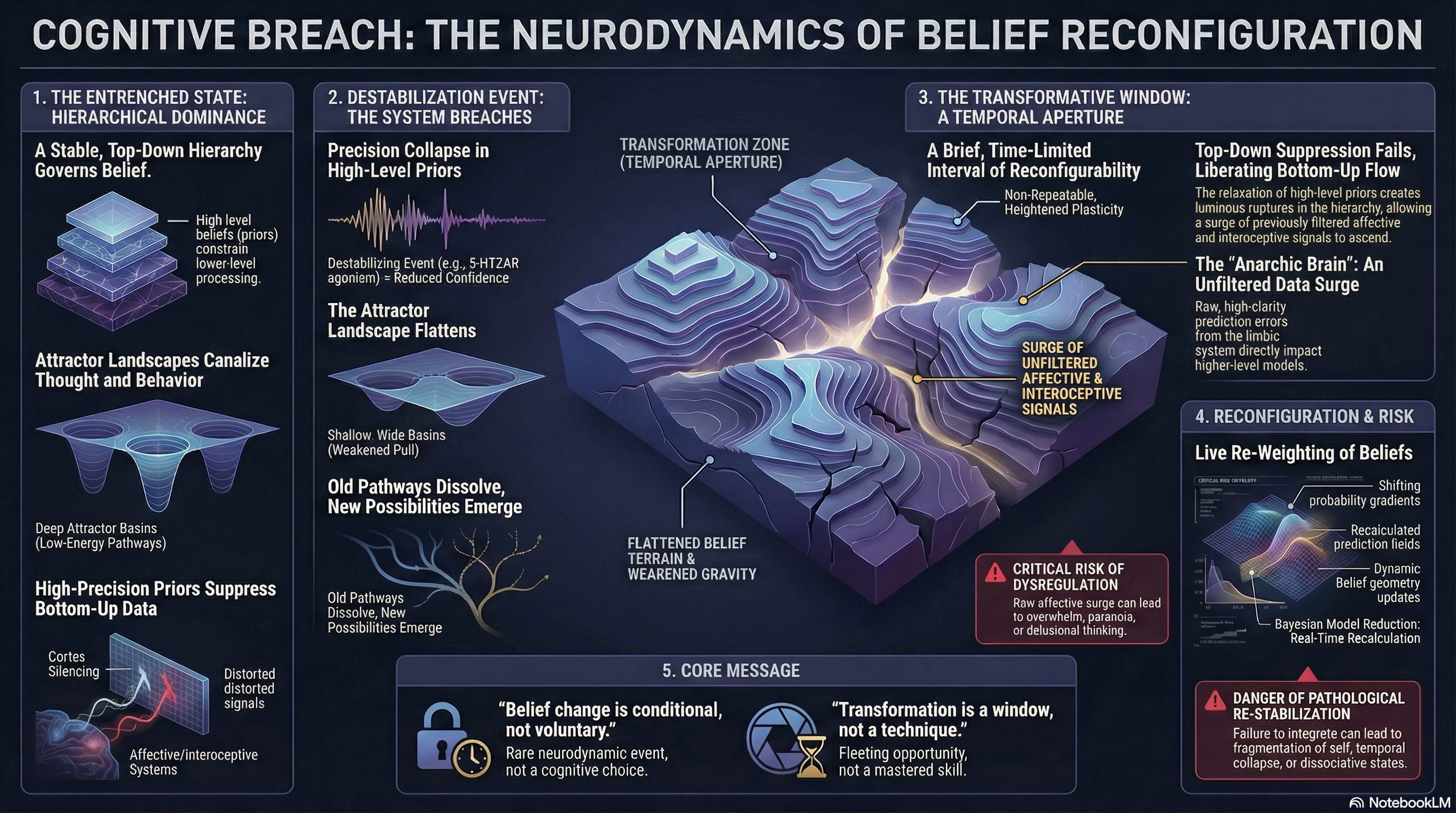
Module IV: Reweighting, Priors & Transformative Windows
As the prelude suggested, this is where we really get into the meat of when belief change is actually possible, its parameters, which are the “rare” states where attractor landscape collapses alongside its hierarchy. It’s important to bring in the temporal scale, because we’re not interested in short superficial change. Especially considering how I just outlined most of the attractor landscape and its priors are formed in our core self. No, we are looking for true change, long-term change, lasting change, a transformation. So what does it take? Simply: The catalyst has to “outweigh” the prior, that’s the traditional route.
The other route is that the catalyst has to, in some way, collapse the attractor landscape and make it “soft”, or rather, pliable/plastic again. Which is fundamentally what change requires, the collapsing of those heavy attractors through valence-charged experiences that relax priors from the bottom up. Because we need that in order to get the higher-order hierarchy layers to “accept” the bottom-up information flowing in. Since these higher-order layers have been quite literally gatekeeping. There are a few of those catalysts that relax priors and collapse the attractor landscape.
Peak experiences, falling in love, becoming a parent, curiosity and even the intention to learn, psychedelics, meditation, psychosomatic trauma release or bodywork, therapy with enormous caveats, specific breathwork practices, divine intervention (hard to summon, but worth the mention), secure Re-Attachment, flow states (related to peak experiences), Profound Awe/Nature Immersion, and lastly targeted neuroplastic interventions, let’s unpack this per category.
Peak experiences:
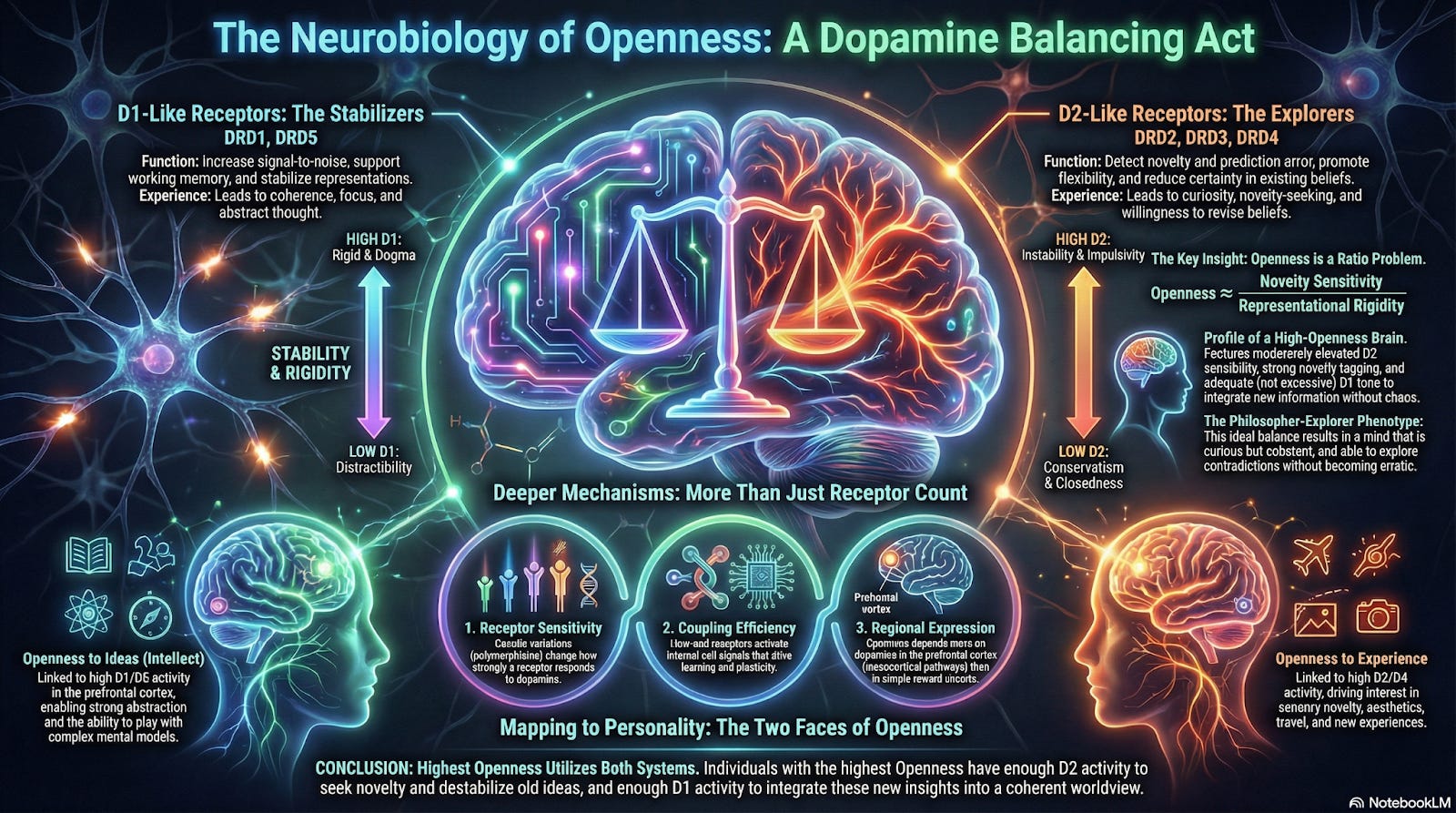
This is intended to cover individual meaningful experiences that you could say are the polar opposite of trauma. This is highly individual because it depends on you, although there is some overlap. People with high encoding fidelity and thin boundaries tend to be more sensitive to peak experiences. Openness as a personality trait is largely mediated by dopamine, but as a synthesis between ratios, sensitivities, plasticity across dopaminergic systems, and how they interact and couple with the cortex and affect. Trait openness is best described as a readiness to update internal models in response to novelty, complexity, and uncertainty. Especially since dopamine is highly involved in precision-weighting. Just realize dopamine has different receptor families, which mediate different responses. Because this also sets the stage for your sensitivity to flow states.
Flow States
Mediated by dopamine, opioids, and serotonin, granted all neurotransmitters are involved, but these are the ones that give it the feel, or affect that it does, and why it very often distorts time and shuts down the default mode network (DMN) and self-referencing systems. Since you are in the moment, but embodied in the moment, “in flow” with the information. Which, if we harken back to our Markov Blankets and attractor landscapes, requires a temporary flattening of the attractor landscape so information from the bottom up can flow (pun intended) without the impositions or constraints the top-down cortical layers would otherwise use, especially in tandem with the DMN being active to that extent. Outside of the neurochemistry of flow, it’s also been typified by a change in brainwaves, such as alpha band/wave suppression in specific regions (such as parietal/frontal during high demand). Alpha here reflects relaxed top-down control, allowing smooth task immersion without over-effort. Which is something they found in the REBUS paper, explored below,
Profound Awe/Nature Immersion
There’s a significant amount of individuality for this, and even state dependence, since, as I pointed out and will point out, dopamine plays such a pivotal role in this. High trait openness, depending on the receptors, in this case D2, which has DRD2, DRD3, and DRD4 as main binding sites, the orientation will be largely outward. Since that makes for the set point of sensitivity, and thus how you respond to things in the environment, whether aesthetics or its extended manifestation as a desire to travel and explore novel environments (these are tightly coupled). Thus, an experience that is high enough in contrast, producing a significant enough prediction error, also flattens attractor landscapes as neurochemistry shifts. For these types, the aesthetics, environment, and expressing their drive to explore are key features for their well-being. And thus help both in expressing their personality and drives, and the neural reorganization that comes with updating their models of reality.
Divine Intervention
I’ve done some exploration of this in my book Platonic Spirituality, the title of which is a misnomer, since it primarily deals with highlighting a prayer Plato has in Laws, for which I lay out the neuropsychology. Or rather, I explore the neuropsychology of religiosity and spirituality. Which is what I point out here, that there are dispositional inclinations that lead to religiousness and spirituality, high trait openness being one of them, connected to its dopaminergic systems and sensitivities, but also how inflammation changes your ability to tap into those experiences, especially considering inflammation has serious effects on dopamine in general, like covering certain receptors and disrupting synthesis. To what degree the divine intervention is an actual external force versus an internal experience matters less for this exploration.
It just works, which is what matters, because it does more of the same “stuff” in terms of flattening the landscape to allow for a re-organization of the hierarchy of beliefs and values. The premise for how a significant shift in biology leads to this is, for instance, seen with the administration of psilocybin. The paper Psilocybin can occasion mystical-type experiences having substantial and sustained personal meaning and spiritual significance - PubMed is a good insight into this (and the REBUS paper to follow, although it doesn’t focus on this particular outcome). Since the shift in dopamine receptor binding also changes how we experience the external world, it affords and facilitates experiences that are spiritual, mystical, and religious in nature, like unity, oneness, being at peace, and tuning in or feeling a higher presence. All of which are typically peak experiences.
Technically, falling in love and becoming a parent, or anything that changes you, would be classified as a peak experience, so it’s definitely functional as a technical term. I also just wanted to use it as a category where other things could be gathered. I kept them for the social layer instead, also because the mechanisms differ somewhat, which I wanted to highlight, as we will look at next.
Social:
The social category could be best named the attachment category, although attachment extends to all of the other elements, since we need our attachment to care about anything at all. Regardless, it comes to the root and thus source of where most of our issues originate, as we explored in the other sections. There are three main avenues for flattening the attractor landscape and relaxing priors.
Falling In Love
Outside of how nice it feels to be in love, it also has a very adaptive function. Oxytocin has a brain plasticity function, and one of those functions is the make the brain plastic so it can unlearn patterns with the precious partner, and thus changes neural connections, setting the stage for integrating this person into your models, Now, to be precise, and I will reiterate this later, this doesn’t guarantee that “everything” will be fixed or sorted at the attachment level. It is an affordance, it will still depend on a host of other biological factors and psychological factors to what degree priors relax and the attractor landscape flattens.
Becoming A Parent
It stands to reason that becoming a parent is a huge prediction error, in terms of your models having to change and update, which again is largely facilitated by oxytocin and its effects on BNDF (the neuromodulator of plasticity). Many experience an overhaul in their orientation, things are no longer about them, but about the child, which is CARE coming online at full force. Very often, that is so powerful that even the drive to survive takes a backseat to keep the child safe. I’ve explored some of these aspects in The Attachment Compass for this reason. Values, incentives, goals, and orientation changing are a central part of becoming a parent as a natural, healthy development of that neurological upgrade, clearly with significant implications in the brain stem, as to what these 7 emotional systems now respond to and orient towards.
Again, the experience with the flood of oxytocin, serotonin, opioids, and dopamine would flatten attractor landscapes and relax priors, so you could nurture, protect and provide for a child. The constraints and the limitations are the same as any of these, when you are looking at a function of degree, it is not a guarantee, as is seen in the abandonment of children. And it doesn’t erase all your trauma, as parents later find out during the developmental phases with their children in terms of how their childhood is mirrored back to them, when they find themselves acting like their parent did, or that the child’s behavior triggers those attractors when it exposes feelings that occurred in the same critical windows.
Secure Re-attachment
Since we outline the romantic angle and the parent angle, there’s a more general premise at play. Which is effectively establishing or re-establishing a secure attachment. This can be familial, like mending a rupture that happened with a parent or sibling. Or it can be a repair of a rupture in any other relationship. It follows the same mechanisms as above, a flood of neurochemicals, a change in brainwaves, a facilitation of rebalancing the ratios between the 7 emotional systems, shifting from negative affect to positive affect, and thus a feeling of safety returning. Which allows the models to update, which runs the predictions you have around the person and the relationship. Which is seen in their function, since opioids act as “consolidators” of relief/satisfaction, making updated models “feel” trustworthy and sustainable.
This precisely fits in our scenarios like bonding (CARE) or play (PLAY), opioids amplify positive valence, making prior updates more likely, contributing up to 50-70% contribution in social reward circuits where they co-release with oxytocin/dopamine. For trauma/overweighted priors, opioids can be crucial (e.g., in therapy-induced relief). We will discuss this in the therapy section. Since they, in the active inference sense, help minimize variational free energy by signaling “error resolved” (homeostatic balance achieved), which is obviously key to therapeutic modalities, but most importantly, relationships.
Interventions
Psychedelics
To explore the effects of psychedelics in our premise of belief states, we’ll heavily rely on the REBUS paper, aptly named Relaxing Beliefs Under pSychedelics and the anarchic brain. It was the one-of-a-kind paper that made this concept click into place for me, the concept of relaxing beliefs, and how they are formed in the first place. Which is why I decided to write this essay in the first place, since it feeds into all my writing materials and what I do professionally as a coach. It also forms the basis for what happens in the psychosomatic trauma release intervention, just from a different angle, which will obviously get to next. Since I think understanding the mechanisms of the process has merit (why else write this entire thing?), I’m going to give a short synopsis of WHY those beliefs relax in the first place.
In the paper, they highlight their main neuromodulator, serotonin. They specify the receptor type, 2A, as 5-HT2ARs. I know it sounds like speaking code, but I’m confident in your ability to understand what the code means. Simply, 5-HT is the chemical name abbreviation for serotonin, which is 5-Hydroxytryptamine. Next up is its family designation, think of it like serotonin’s last name, in this case, 2. It follows the same logic as the receptor families we explored for dopamine. Next, we have a subtype within the family of 2, which is A. And finally R, which stands for receptor, denoting the protein structure. The chemistry lesson on serotonin is over, so let’s move on. What they found was that these specific receptors were richly expressed in certain areas, such as the visual cortex. If you’ve done any psychedelics, this will be easy to relate to as the driving cause behind why you have visual hallucinations.
Most notably, it is most densely expressed in the cortex, and especially in high-level association regions, such as those that belong to the default mode network. Which tracks with that, with high enough doses, the disruption in the higher levels becomes more profound, hence the dissolution of ego boundaries and the potential for long term revision of high-level priors, perspectives, or beliefs. In recent work by Madesen et al, 2019 (I’m mining the REBUS paper’s references for all they are worth), theory found that 5-HT2AR occupancy and plasma concentration of psilocin (the active metabolite of psilocybin) correlate with psilocybin’s subjective effects, in a nonlinear way that matches the nonlinear nature of psychophysical phenomena such as ego dissolution. Which revealed another bio-individual component.
So why this focus on the DMN? It does keep coming back a lot across various fields of research and their literature. Because, as they relate in the REBUS paper, the human DMN can be considered to sit at the top end, or center, of a uniquely deep hierarchical system, meaning the human brain, instantiating a uniquely deep and domain-general model of the embodied agent itself. To wrap up the importance of the DMN, they emphasize that they maintain that the highest level of the brain’s functional architecture ordinarily exerts important constraining and compressing influence on perception, cognition, and emotion, so that perceptual anomalies and ambiguities, as well as dissonance and incongruence, are easily and effortlessly explained away via the invocation of broad domain general compressive narratives.
The last part effectively emphasizes what we explored when it comes to the loss of information between these higher-order and lower levels, hence the domain general compression, since that’s what the higher-order layer needs to function. These were all important, which we should keep in mind when we move through the rest of this essay, since the involvement of the DMN and the higher-layer processing is central to letting bottom-up information flow back up. The effects of serotonin, in this case, are flattening the attractor landscape and relaxing priors.
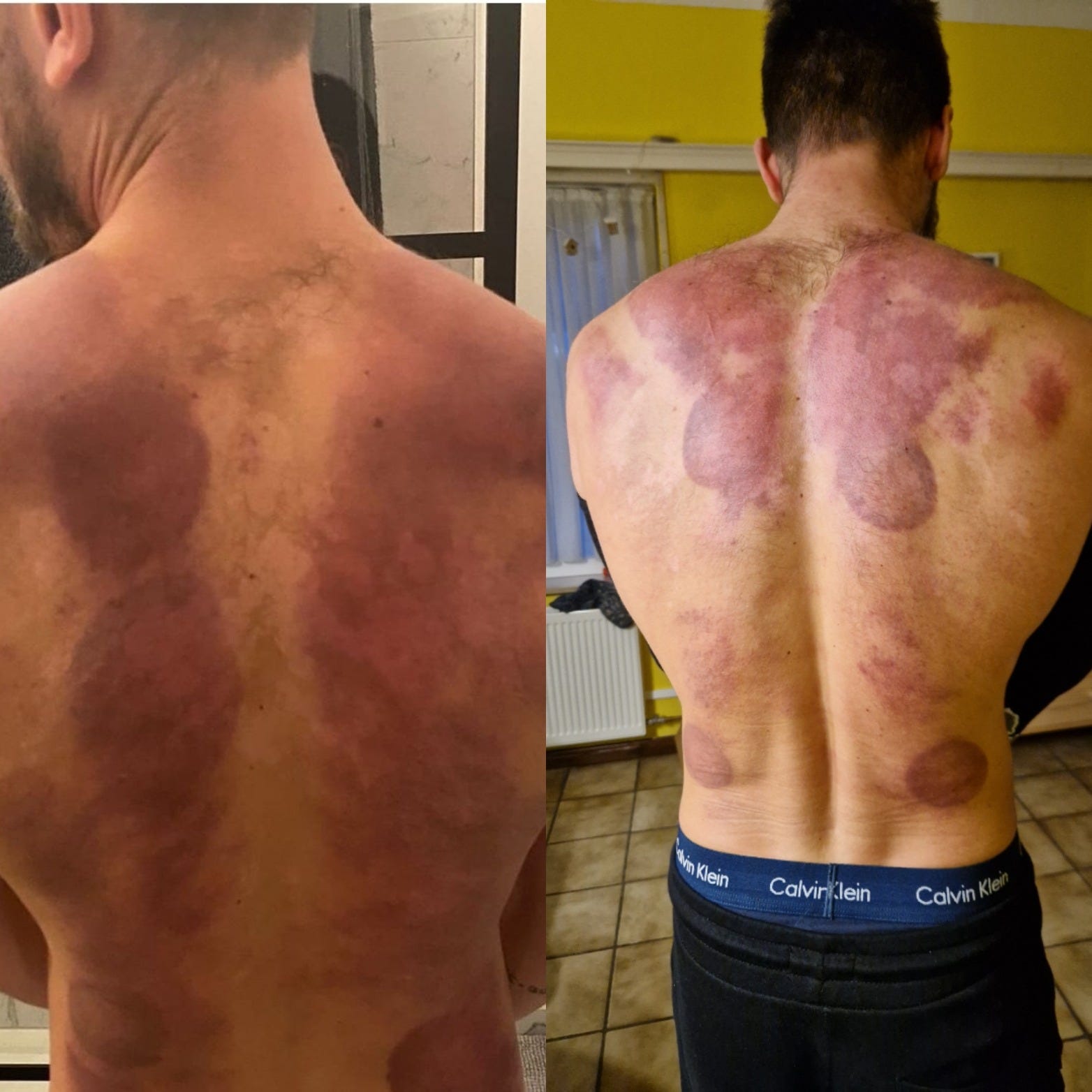
Picture of session 1 in December 2021, second picture in December 2022
Psychosomatic Trauma Releases / Bodywork
A lot of people have heard of the book The Body Keeps The Score, by Bessel Van Der Kolk. The premise is sort of correct, though, seeing that the brain is embodied and embedded, there is no actual separation between body and brain. The body is the brain, and the brain is the body. Which is also why tension and movement are connected to emotions.
Think about it from an evolutionary biology view: if something is bad for you, or even worse, is attempting to eat you, you need a mechanism that propels you away to increase the chance of survival. Affect is that driver , as we saw, that tells us what is good and bad for us, and the motor cortex is the action facilitator: approach and avoid. Avoidance means “running” away from the threat to ensure our survival, whether it means toxins or a predator. Here’s one of the implications that is often missed, which means that a lot of the tension we experience in the body is de facto psychosomatic due to those affective experiences we talked about. You can stretch and stretch, and shake, and do TRE, but if it doesn’t reach that core part of the brainstem where our affect lives, there’s very little lasting results in tension. Don’t get me wrong, those practices have some merit, but they rarely get to the deepest layer. Which is my point. I have had 3 major releases, and the difference in my body is no short of a miracle.
For me personally, it felt like I’ve been suffocated by my own body. This isn’t a metaphor, my neck muscles were so tight I couldn’t breathe, and I had to stop training a few times as I found myself in a hypoxic state (oxygen-deprived). I don’t need to draw a picture to show that this is really bad. A large part of it originates in the psoas muscles, which have correctly been identified to be an issue for people, but there are caveats upon caveats here. I’ve been doing hip openers since I was 20, so for 14 years, I have done different stretches, mobility drills, openers, weighted mobility/stretching, stability, physiotherapy, massages, foam rolling, fascia release, you name it, I’ve done it. None of them ever got to that depth, precisely because of what we explored in the separation between these layers and that it just wasn’t possible to go that deep with certain tools or certain settings.
I did 3 sessions with Cliff Tang from Kaizen Project in Belgium, this third release was the first time I can remember that there is physical space in my lower back, literal breathing space in my lower ribs, which has been an issue for as long as I could remember, despite doing breathwork practices for almost the same amount of time as I have been stretching. I’ve been in the game for quite some time, because unfortunately for me, the damage done to me was significant. The thing is, physical breathing space and “mental”, or rather, emotional breathing space to go together. Which stands to reason, given how we just linked the motor cortex to emotions. Your muscles and their baseline tone (tension-wise) aren’t disconnected from the motor cortex and your affective center in the brainstem.
Functional neurology
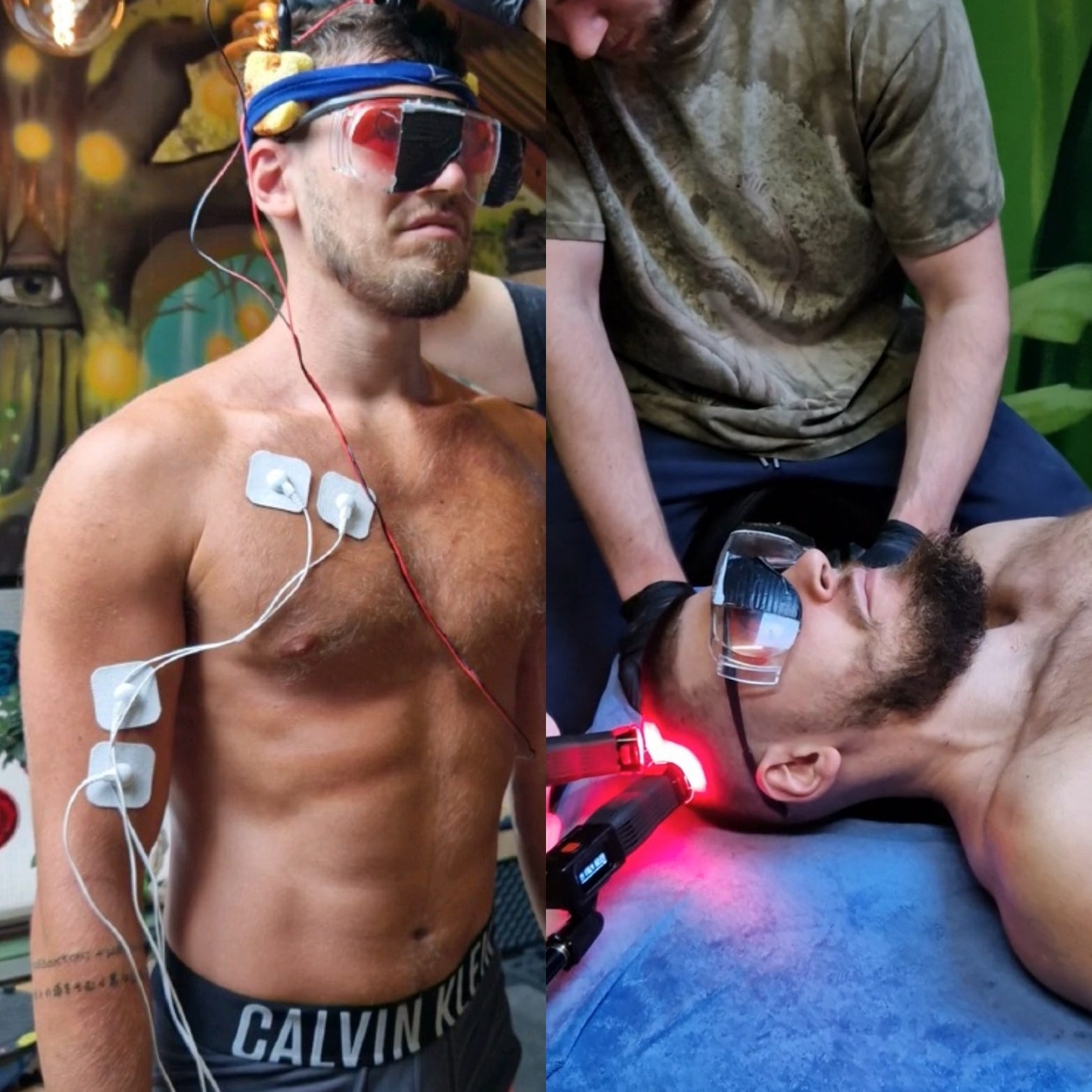
This one is a bit harder to quantify, even though the premise itself is relatively straightforward. The use of something like therapeutic lasers can target and change parts of the brain that respond to that frequency and wavelength, especially when it comes to hyperactivation and hypoactivation. This would denote an activation issue in a specific brain area, which is either overactive or underactive, something I mentioned by using an example of the amygdala and the HPA axis, as they can be prime examples of this, but it obviously extends far beyond those two. Another aspect of functional neurology is attempting to balance the hemispheres, thus allowing their communication to improve, which allows for hemispheric integration and balance. Since these two hemispheres have separate functions and different areas of expertise, to simplify it as such, it stands to reason you’d need a way to align communication, “translate” and integrate it. Which is what those treatments can do, eventually, through a host of tools.
I’ve done 16 sessions with Dries from Vision4body in Belgium, which marks about 4 years since my first session in February of 2022, when I was hospitalized for heart issues due to severe burnout. I had tachycardia and arrhythmia together, which can be fatal ( that was a close one). Tachycardia is when the heart rate suddenly shoots up from rest to a high pulse, whereas arrhythmia is when the heart starts skipping beats. This is obviously not an ideal combination, even having one of those is not a treat. I literally thought I was having a heart attack. My nervous system was just completely fried. 3 months after my session with Dries, my symptoms were gone, and have stayed gone. Mechanistically, it will have to rely on the other fundamental parameters of neuromodulation or manipulation, electromagnetic, like brainwaves, and neurochemical, which all contribute to flattening attractor landscapes and relaxing priors. Though again, as usual, the caveat is that it affords you to do deeper emotional work, it doesn’t one-shot all your trauma. Remember, different parts of the attractor landscape need different modalities of intervention.
Meditation
In the very same REBUS paper, they also mention meditative states. They do so because of the overlap between these states and psychedelic states. They mention that neurobiological similarities were the focus of a paper by Miliere et al in 2018, and that the other major community was the relaxation of self-consciousness as explored by Batchelor in 1998. They summarize the similarities that were found with brain imaging as: relative deactivation of the DMN, reduced anticorrelation between the DMN and networks concerned with processing the extrinsic world (both based on works of Carhart-Harris), and the enhancement of signatures of criticality (Atasaoy et al 2017). Criticality would be the point at which there is a phase transition state between rigid order (stable, low-complexity patterns) and chaotic disorder (random, high-noise fluctuations). More concretely, think of it as the building point of “pressure” that requires a transition from one state to another, where you hit the sweet spot that maximizes information processing, adaptability, and dynamic range. To reach criticality, something has to be happening beneath the surface that drives this phase transition. Which would be entropy as neural signal complexity, signals and information building up in the background that those higher order layers are poised to suppress in normal waking states. Which also speaks to the dose dependence both with psychedelics and these meditative practices, since depending on your priors and your individual baselines and set points, not everyone will switch over at the same point, since the amount of entropy tolerance in this way would vary. Interestingly, these overlaps suggest meditation can mimic psychedelic prior relaxation endogenously, through sustained practice rather than pharmacology, which is exactly what I have experienced due to my thin boundaries and encoding profile. meaning I seem to be more sensitive to this anyway, so when I practiced meditation, I got to certain states that also brought those spiritual, mystical, and religious style experiences (unity, oneness, etc). My new book, The Intuitive Self, will explain this in depth, why there is so much variance individually for this, although that’s an implicit case we have been exploring, and I have been making when it comes to how all of these elements affect someone.
Specific breathwork practices
The one I had in mind here is one I did at Breathwork Bali, based in Canggu, when I was there with my client, upon invitation. It’s typically called Somatic breathwork or somatic breathwork for trauma release when the focus is on psychosomatic/emotional processing via the body and breath. I can only speak for the modality, space, and facilitators that I have experienced, so I can say that this was quite insightful. Now, to be very concrete, considering I had already experienced the psychosomatic trauma release with Cliff from Kaizen Project in Belgium, twice at that point, and I was in a great state (very important to emphasize), what I felt was basically extreme euphoria, I wanted to get up and run from joy, and dance and sing or scream from happiness. This came after a pretty significant period of being and feeling unhappy related to my circumstances and lack of opportunity to move back to Oslo (which is still a driver of separation distress). The nuance is added because, as I was experiencing profound euphoria, others were screaming and crying profusely. So the intention, state, and previous prior relaxing modalities matter a lot. This doesn’t take away from its merit or avenue as an approach, just that it, in my experience, and what I garner from all the literature I’ve been delving into, it is less potent than the psychosomatic trauma releases I’ve had. Which most likely has to do with the depth or weight of my priors to begin with. Although it stands to reason that the approach Cliff has tends to go deeper.
Therapy
Therapy is far more nuanced than people give it credit for. Primarily because they conflate therapy with therapeutic. A bad therapist doesn’t make the relationship, the session, or the modality therapeutic. The level of safety, resonance, attunement, and empathy make a relationship or social experience therapeutic. Traditionally, this was a shared role between elders and some peers in a natural social system. Since those who had already gone through those experiences could guide you through it in a safe space (whether or not that was ritualistic, mythical, or religious). This “duty”, or rather responsibility, was then relegated to a specific role like shamans, priests (pagan or otherwise), sages, philosophers, doctors/medicine men, or anything of the sort. They could set the space and the practices that had therapeutic benefits, which fostered the safe exploration and mapping of the event, circumstances, identity, and feelings in question.
As social integration withered and social complexity increased, these roles have fallen to psychologists, psychotherapists, psychiatrists, and other therapists. Interestingly, the therapeutic benefit is far more driven by the attachment with the person than anything, and the biological processes that underlie interpersonal synchrony, or attunement, and right brain structures coupling through co-regulation. If anything, it providers an emotionally safe space to explore and map the concepts we highlighted, that is, the circumstances that have formed the priors and the attractor landscape that keeps pulling you in, free of judgment, or more precisely free of the predicted response that have been instilled in to you when you communicated or showed, expressed these feelings, states and the corresponding behaviors. That’s also where the prediction errors afford the space to start updating models, provided the neurobiological state allows for it.
When we revisit the role of endogenous opioids here, in light of our framework, they facilitate error dampening and hedonic reweighting. Opioids reduce “unpleasure” signals (escalated prediction errors from allostasis/homeostasis threats). As such, they signal “relief/distress resolution,” lowering free energy and relaxing negative priors (FEAR/RAGE dominance). This flattens threat-based attractors by shifting valence positive, allowing bottom-up evidence (new sensory data) to update models more easily, exactly as we saw before. Opioids regulate moment-to-moment synaptic signaling, suppressing overactive circuits (stress/threat hubs like the amygdala) while enhancing reward ones. And since they co-release with the other attachment neurotransmitters and hormones, it speaks to the importance of social bonds, which is what the driving sentiment is behind The Attachment Compass.
Aligned with this corelease is the creation of “windows” where attractors soften, as opioid-mediated relief in social touch reduces cortisol, synergizing with oxytocin’s hierarchy-flattening to allow prior reweighting, and serotonin adds to the process by stabilizing the new landscape post-relaxation. Since opioids are released in the midbrain (VTA/PAG) to resolve diverse needs (pain, stress, attachment), this means that in inference terms, this “resets” error signals, relaxing priors tied to unpleasure. Which gives a pretty clear basis for why so many things, people, and even animals can be therapeutic. Though to come back to therapy, there is most certainly a lot of potential when it checks all those boxes. Especially when it is the first secure attachment a person might have, no matter how tragic that is in light of our need to be socially integrated, accepted, and loved.
Curiosity
I know this module is supposed to simulate a special forces selection on a cognitive overload level, so I’ve thrown a lot at you, let’s take a breather by keeping it a bit more psychological. Curiosity, aligned with Panksepp’s SEEKING system, and what we explored on the differences in dopamine sensitivities, is another avenue through which we have the softening of priors. In some ways, I consider it a meta drive, since for some outliers it pushes them beyond the self-conservation/survival mechanism, which speaks to its potency. It also gives a lot more weight to the saying that curiosity killed the cat. Those with high trait openness, dialed up to the maximum, are naturally exceptionally curious, always looking to understand and explore. As one of these types, my explorations have burnt me many times, which seems to be an inherent part of the process, since it’s also inherently tied to our ability to learn. Curiosity comes with frustration and satisfaction, which are valence and hedonics of learning.
I think the satisfaction of curiosity in general is self-evident, I’ll emphasize frustration’s role in learning. Frustration escalates prediction errors, pushing for satisfaction’s resolution. It’s kind of the signal to shift to another gear, or to take a closer stock of what the problem might be. To my surprise, in the REBUS paper we explored in the psychedelics section, they even mention the intention to learn in the section on the mechanism of insight. Effectively, they found that in the literature on creativity relating to insight, the initial phase involves intention or plan to discover something new. It is supposed to serve as a heuristic to relax one’s confidence in one’s prior assumptions, these high-level priors, and, in doing so, promote an open, inquiring state of mind, operating under the assumption that there is something to be learned, which relies on a degree of expected uncertainty. Effectively leading us back to SEEKING, since it is based on exploring novelty for the sake of knowledge gain, rather than something else.
Since I’ve been coaching professionally for going on 16 years, I’ve been privileged to see many individuals come through in one form or another. With clients as with friends or close ones, I’ve often deeply reflected and contemplated what these key factors for change were. It seems to me that suggestibility, willingness and openness have varying levels of prior relaxation and can collapse certain attractor states, especially when feeling accompanies the new information, whatever evidence that may be. This is a key feature of coaching when you are mapping someone’s neuropsychology, but also exposing their patterns and behaviors. It is not easy to be confronted with those, even when it is brought without judgment, since we saw that beliefs and self-perception are connected to survival.
As they also explicitly state in the REBUS paper, beliefs are self-protective, it is natural that psychological resistance will be felt if their integrity is threatened. Which is why, as a coach and a good friend, it is my responsibility to gauge their windows of openness and willingness, instead of trying to force my way in with the crowbar of good intentions, which tends to have the opposite effect (hard lessons learned). The other element is that the evidence has to change to such a degree (intensity) that you have to shift your view, which happens more often when you’re reading deeply into scientific literature and have to update your model, since that was the premise of the intention to learn. Even though SEEKING and curiosity all come together to relax certain priors, it does have some constraints. It would be unwise to expect these to change the heaviest priors we talked about in terms of trauma, although they can add perspective or change the frame around certain experiences.
So what about meta-belief, like believing in yourself?
There’s a bit of a paradox here. I’ve done plenty of things without any actual conceptualization, whether or not I believed I could do it in the sense of end states. Three concrete examples stand out:
I started Krav Maga without any belief I could ever get to black belt level (or Expert level).
I started reading research without even a hint of the possibility that I’d be reading computational neuroscience literature like Karl Friston’s work.
I moved to Oslo in 2015 without any real sense of knowing or believing I could make it. I just had to go. Which to me means that my affective belief state was far more powerful than anything I could’ve come up with cognitively.
Consider this as SEEKING overriding doubt, with an unintentional superseding of many other drivers, or core aspects of these 7 emotional systems. Since we’ve spent so much time going through the deepest possible layers of belief, it shows the outlines of the limitations. It’s a very popular notion that you “have to believe in yourself harder, better, deeper,” etc.
The how just never seems to make it to the cut. And when it does, it is about acting, or behavioral patterns, which is fair in the correctness of the premise, but boy, do they miss the scope of the drivers. More awareness, more meta-cognition, more consciousness don’t change anything as long as those priors are deeply baked into your brainstem. Which is obviously what I’ve been pointing out this whole time. Beliefs are hierarchical affective priors, not cognitive selections, since you clearly select so few of them yourself. As John Vervaeke would often say, “necessary, but insufficient”. Since those aspects can provide your insight and understanding of what is going on at those lower levels.
The affordance found in some of the interventions is the re-opening of critical windows, essentially collapsing particular attractor states or segments of the attractor landscape, since it rarely does everything at once. Which is important to emphasize. The very same principle they established in the REBUS paper relates to the developmental windows we talked about in childhood. They go on to say that serotonin transmission is known to play an important role in normal brain development (Azmitia, 2001; Maya Vetencourt et al, 2008) and has been increasingly linked to enhanced sensitivity to environmental influences (Brankci, 2011; Alboni et al, 2017). Relatedly, psychedelics appear to induce a regressive state, both behaviorally (Grof, 1979) and in terms of brain function (Roseman et al, 2014; Carhart-Harris et al, 2016c).
Moreover, as in infancy, the influence of context has an exaggerated role under psychedelics (Carhart-Harris et al 2018c), a characteristic property of critical systems linked to critical slowing. I know I’ve been throwing around concepts left and right, so let me refresh the critical concept that is referenced here. It refers to a critical point, the phase transition between order and disorder. Effectively, between the normal state and our new high entropy state. Critical slowing refers to the property of being slow to recover from an experience like that. Think of it like how throwing a little rock in a pond creates ripples. Critical slowing would just mean more or a longer ripple effect, since that was “the experience” and then the waves are the aftermath and how long things take to settle. Another way to put it is that the window stays open due to your landscape attractors still being flattened, taking longer to reshape, thus your priors staying relaxed longer.
For most of these modalities and interventions, the sales funnel and marketing of a lot of these interventions rely on the “one-shot” success story. No one became a champion overnight. Just like no one becomes a Delta Force operator overnight. Since we’ve talked about these layers and their Markov blankets and temporal scales, we need to acknowledge them and emphasize them. Different neurodevelopmental phases and windows, different states and circumstances, all change which part of the attractor landscape you are tapping into. One of my meta-drives is one of synthesis. I believe in stacking the deck in your favor by addressing the various levels of social interrogations and types of interventions. I don’t believe in a one-size-fits-all solution, and I don’t believe everyone needs the same thing, at the same dose, at the same arbitrary time frame. Just like your needs in general vary, so do the needs and fittedness of these interventions.
The intention here is to explore the effectiveness of interventions and their mechanisms. Since the work typically needs to happen at the same level or layer where the issue has been caused. There’s a saying that loosely leans in this direction: “We cannot solve our problems with the same level of thinking that created them.” Although we could rephrase it to stating that we can’t solve our problems from a different level from where they are created. Our deep affective priors that got shaped during those critical windows in our childhood aren’t math problems to be solved by logic and reason. Since they clearly exist at a different level, and need what that very level functions on: affect. Coming back to the windows of opportunity and plasticity of the attractor landscape, it is quite common after these experiences to want to keep the windows open, which is more like wanting to keep the landscape plastic, which can, of course, happen. However, the attractor landscape should set and settle so the hierarchy of informational flow can function properly, which is also contextual.
Creatives tend to prime, stimulate, or force this window back open because they “need” it. Though that can also express itself as an unbalanced emotional feature, some of those priors in the core are not fully addressed or resolved yet. That’s why integration is key, and letting the attractor landscape settle so you can first learn how to navigate the new landscape, with an updated belief structure.
“When the prior belief structure is efficient, and its modes are distinct, the posterior models formed by integrating evidence are also less likely to be ambiguous or highly overlapping. This lends to more robust and interpretable inference, as the network can more clearly distinguish between different explanations for the sensory data.” (Tamas Spisak, Karl Friston, 2025).
Given the muck I’ve dragged you through, intellectual torture, dropping you in the middle of the action scientifically, you can see why I made the case that this is the turning point to turn you into a special forces worthy operator. That is, when the various parameters, modalities and interventions have been hit, hitting you at the very core. The transformative process is about transformation afterall. No one is going to walk away from reading this being transformed. In some ways, it opens up the landscape, gives a glimpse of the horizon, and helps you understand the scope of what you are dealing with. In a similar sense, when you pass special forces selection, you aren’t a full-fledged operator yet, you actually still have to go through all the training and integration into your unit. Sucks for you, new guy. Just when you thought it was over, this is where the learning actually begins. Instead of scrubbing toilets or giving you pointless tasks to get you to understand your place in the unit, we’ll keep the education process alive. So, just sit down and shut up, and keep paying attention, alright, new guy?
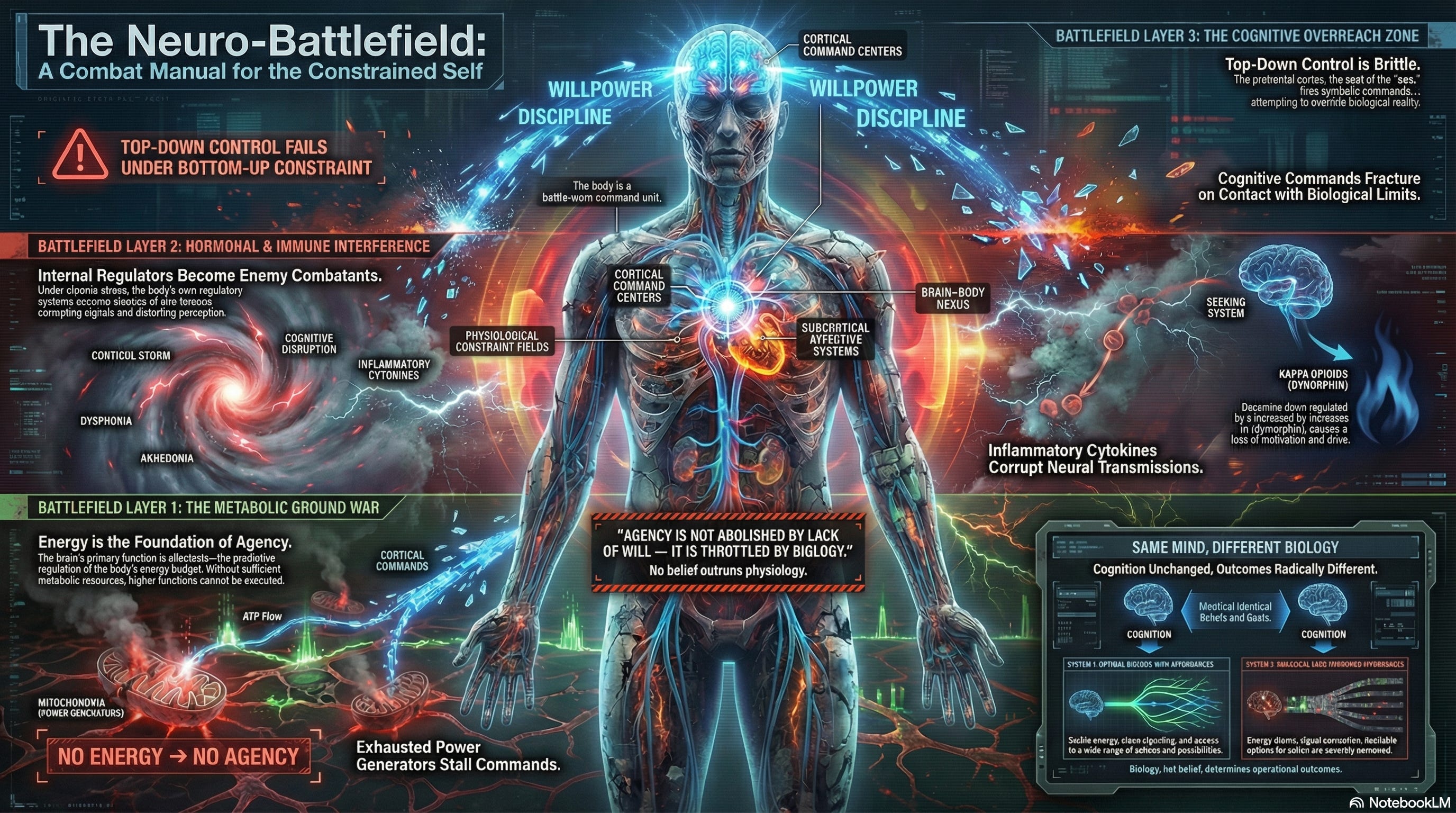
Module V: Biological Constraints
The outline of why belief change is not “just mindset” or a mindset thing should be absolutely clear at this point. If it is not, you get recycled to the next class running selection process, and you have to wade through the muck again. Should there be an inkling of doubt about what I’ve been talking about, get your personal tutor involved, load it into any AI of your preference, and get it to clarify the material until it’s coming out of your ears. Look, I get all the mindset stuff, in a certain sense, it is important, and I understand the appeal of placebo, but we’d be making a colossal and even cosmic scale error if we didn’t acknowledge they (mindset and placebo) have limits. Because the general paradigm is that “it’s just placebo, bro, so you can just like placebo yourself, you know? Bro?!”
As a principle, everything follows a distribution over a bell curve. Some people are highly responsive, outliers on end, the majority in the middle have some effects, and another outlier minority has zero effect. Now, this doesn’t generalize to placebo findings, because anything placebo is constrained by the context in which it happens. Outside of that, I consider this to be simple logic, you can see it reflected in a study like Placebo effects in randomized trials of pharmacological and neurostimulation interventions for mental disorders: An umbrella review | Molecular Psychiatry. Which showed that the placebo effect sizes vary widely by disorder and are generally larger for clinician‑rated than for self‑rated or objective measures. No shit, right? This is just one example of a constraint, there are so many.
The point isn’t to challenge that placebo exists, or that it doesn’t have the potential to play a significant role, it does. Rather, it is to point out that it is a real psychoneurobiological phenomenon driven by expectations, conditioning, and contextual factors. So if we explore the mechanisms of it a bit more, rather than highlighting various demographics, I think our time and attention is better spent on the former rather than the latter, because it brings more clarity. Apparently, genetics explains about 20-50% of placebo variability, with polymorphisms in neurotransmitter systems altering receptor function, reward processing, and hedonic reweighting. Before we move on, I want to emphasize that just like any part that we are exploring, as a mechanism, genetics are complex, we can keep complexifying until your head spins, and you feel you want to puke. There are deterministic factors we have to account for, and there are plastic factors we have to account for.
Just because genes are one way or another, doesn’t mean they can’t be modulated in some sense, beyond the obvious hard-wired constraints of course. The main ones we will highlight now are unsurprisingly the neuromodulator genes, of those very same modulators we’ve explored: Serotonin, Dopamine, and Opioids. The significance, at this point, should not be lost on us. Starting with serotonin:
Serotonin:
Variants like TPH2 G-703T reduce serotonin synthesis, lowering placebo in mood disorders [1][2].
Dopamine (COMT):
The Val158Met variant affects dopamine degradation; Met/Met homozygotes have higher dopamine levels and stronger placebo responses, while Val/Val show reduced effects (less reward anticipation in expectation paradigms). This links to individual differences in affective priors [1][2].
Opioids:
And finally, for the opioid system (OPRM1 Gene): The A118G polymorphism reduces mu-opioid receptor binding, limiting placebo analgesia. In pain studies, carriers show 50-70% weaker responses (less endorphin release during conditioning). This constrains the effects of placebo in chronic pain, where opioid pathways are already dysregulated [2][3].
Considering the amount of time we took on outlining the effects of those neuromodulators on our experiences, neuroanatomy, neurological function, and what it does to our attractor landscapes and priors, it makes sense that changes there have significant consequences across the board. That would also mean that any factor that disrupts that, like stress or inflammation, would have an impact. Which is clear in the data on chronic inflammation (elevated cytokines like TNF-α, IL-6) and how it tightens priors and blunts placebo by altering neurotransmitter balance and immune-brain signaling [2][4].
Here’s another one that few people expect: the vagus nerve, which runs from the brain to the viscera (your organs), has a ratio of fibers that are the highways of the direction of communication. Meaning one bundle that is a highway that is brain-to-body communication. And the other bundle is body to brain communication. Hence, when these vagus nerve ratios are generally distributed as: 80% afferent (bottom-up signaling) vs. 20% efferent (top-down regulation) that tells us that this ratio is crucial for placebo, as it conveys safety cues (via interoception) to relax threat priors. Which brings us to two crucial points: individual ratios most likely differ (since all other organ shapes, etc., are also individual, but follow a general pattern), and when there is a high amount of inflammation in the vagus nerve, communication will be highly disrupted.
The microbiome, our gut, plays a central role in all of this, since it and the immune system are the ones modulating these inflammatory responses (obviously, in tandem with the brain, it’s not an isolated system). The driving factor is that dysbiosis heightens inflammation, further blunting the placebo effect via vagal disruption. Paradoxically, or maybe not at all, all these constraints amplify nocebo in vulnerable profiles, turning ‘mindset’ attempts counterproductive, since that would drive up pain/unpleasure/displeasure. What’s even more incredible, and we’re really way ahead of the curve here, is research done by Michael Levin that shows that your immune system is a part of your cognition, with the paper The brain is not mental! coupling neuronal and immune cellular processing in human organisms. Which connects how you can get sick from those affective priors, since they affect the immune system, are also innately connected.
Most of what we just explored, if not all of it, extends into the many factors that go into why someone has an easier time changing others and a harder time, beyond the attractor landscape, since so much of it is based on genetics, epigenetics, and all the other alterations that can happen in neurotransmitters, neurotrophic, and neural architecture. Hence, outside of the general premise that your meta-cognition already is severely limited from reaching your deep affective priors, it’s even more limited in changing your hard-coded genetics. Which again enforces the notion that there is a significant split, distance, or separation between belief states, affective models based on your interactions with the world, and your cognitive beliefs you try to enforce, even when the former largely drives the latter.
It highlights clearly how and why there is such significant variance in how people respond to, well, anything. And thus why there are bio-individual constraints, from this entire psychoneurobiological level, on which modality, tool, and intervention will work for you. Which is why I rarely put any emphasis on someone ringing their sales bell proclaiming this thing or the next thing as the “end of all things” or “the last and only thing you will ever need”. What works for you works for you for a reason, and even that is highly state-dependent too. Furthermore, all of these expose and highlight weaknesses in our armor and arsenal, which is why we need to understand them so that, in the first place, we can safeguard against them, and in the second place, that we understand the enemy and their weapons. The next module briefing puts you face-to-face with the enemy. I hope you’re ready to tango.
[1] Understanding the mechanisms of placebo and nocebo effects
[2] The Biology of Placebo and Nocebo Effects on Experimental and Chronic Pain: State of the Art
[3] Neurobiological Mechanisms of the Placebo Effect | Journal of Neuroscience
[4] Placebo effects and the molecular biological components involved - PMC
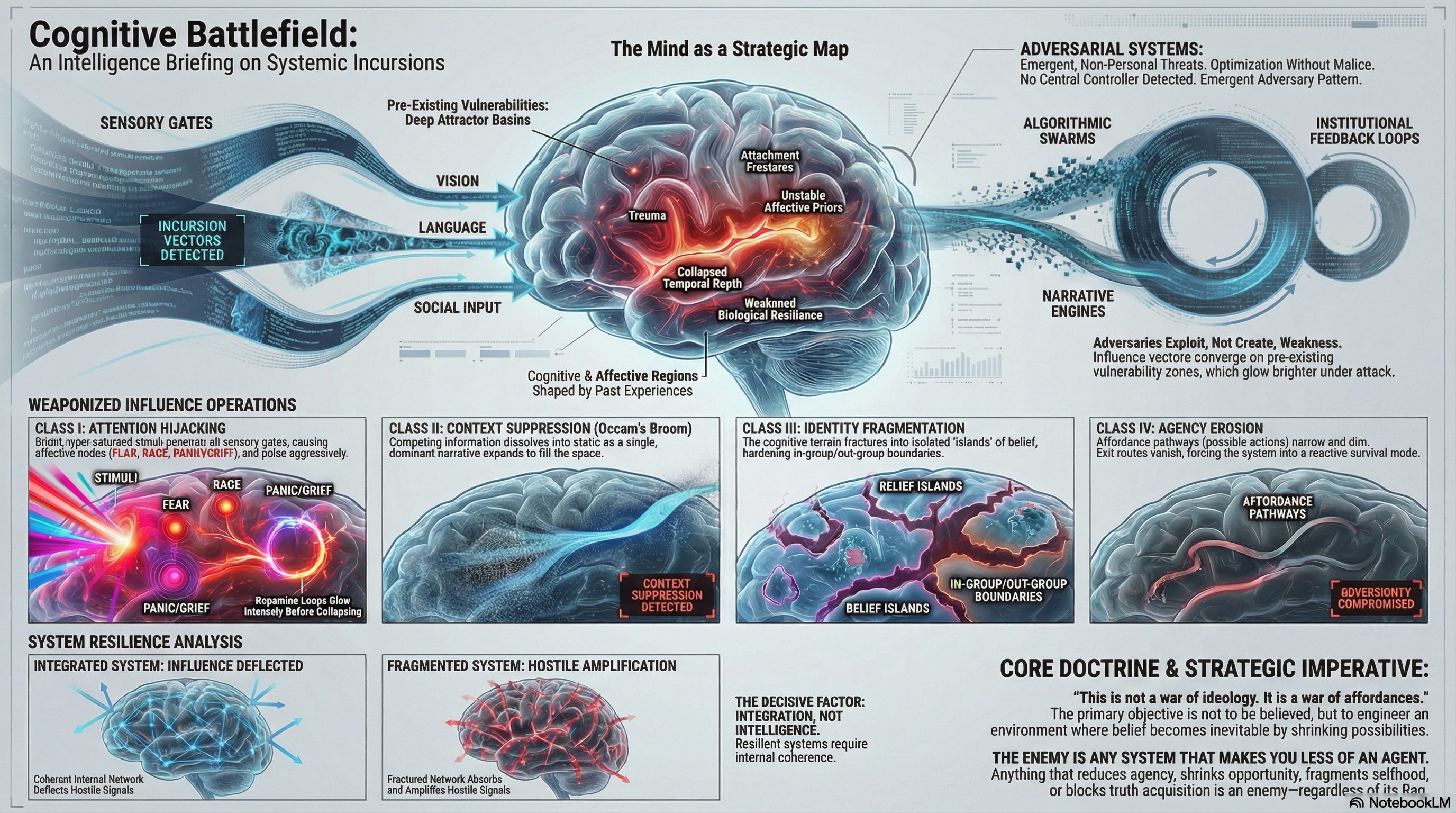
Module VI: The Enemy And Their Weapons
It’s a war we’re in, right? As such, wars have enemies and weapons. Now I’m aware that in the psychology of war, dehumanization is a thing, so I want to be very clear about who we brand an enemy, and also state to take this with the nuance, complexity and differentiation it deserves and requires, since I’m not attempting to single out an entity, but a pattern or organizational pattern. As such, let’s attempt to circumvent overdramatization and extreme conspiracy theories to keep this grounded.
Some people, corporations, institutions, officials, governments, agencies, they are all out to influence, manipulate and control you. At a certain level, or at a certain expression, they function similarly to how human psychopathology does. These instances function similarly to psychopathic, narcissistic, and sociopathic. I’m not saying everyone at all times, or not every instance I mentioned as an extension of the social-political-religious-cultural domain, but it is undeniable that there are many. Social media platforms and algorithms are no different. To be clear, I don’t think there is a particular, cohesive, or properly defined “they”. I just consider “them” to be anything and anyone who tries to manipulate those core aspects.
If, or rather when, these instances function like psychopathologies, that also means they generally find the same type of victims. Which are the vulnerable ones, with those trauma-shaped attractor landscapes, with fragile identity constructs, and sensitive strings that can be pulled and prompted. That’s why integration and this work matters, as I will elaborate on in the last module. The pattern you ought to look for is whatever makes you less of an agent, Makes you less sovereign, disregards affect, blocks opportunity, makes you weaker, less healthy, less of a human being, and discourages your quest for the truth, answers, clarity and more information, or forces you to act, think, believe and feel a certain way (hence an encroachment agency).
One of the often-used tools is what Daniel Dennett coined as Occam’s broom. It effectively stated “disregard all the other information”. It is like a magician’s sleight of hand, making you focus on one thing so something else can happen. You shouldn’t disregard other information or what came before, because your entire attractor landscape is formed by the previous data. This isn’t always malicious, but surely disingenuous, and it is typically found in getting you to buy into a type of one-dimensionality or denial of some aspect/level/layer of self. The primary examples of this are those that:
Only focus on the body and not the mind, or rather only focus on affect.
This can come in many forms. Hedonism is one, the often trauma born driver to focus only on your looks since that might mean social acceptance and sexual selection is another. It also sets the stage for a lot of infantilized paradigms like the body positivity movement, and the pop psychology self-care above all else, toxic positivity, and thus that whatever you feel becomes the excuse to justify any ends and means. I’d argue the worst form of this, outside of hedonism and addiction, is the weaponization of psychological concepts. We’ve obviously covered the importance of affect, however, we have cortex inhibiting impulses for a reason, with the capacity to think in multiple orders of consequences. It’s tempting for a certain cohort of people to adopt these paradigms since it absolves them from any consequences or use of their higher-order faculties (to whatever degree these haven’t been damaged to begin with). Abandoning reason and logic isn’t going to do anyone any favors. And as usual, this is an amplified response at the other side of the demographic distribution at the end of that bell curve. If we’re looking at it from a trauma-informed angle, this would be driven by PANIC/GRIEF avoidance.
Only focus on the mind, “Descartes error”, and thus neglect the body and affect.
This is mainly for the logic-is-everything guys, it’s predominantly men who fall in this category. Since reason, logic, and structure or order are their wheelhouse. It’s more typical in the left-brain dominance paradigm, as an oversimplification that has some merit since that hemisphere deals with details and abstractions. Though there’s something that could be said about ideologies and practices that require you to abandon the body, since that is something that also doesn’t make any sense, given what we saw with Antonia Damasio’s example of what happens when someone’s emotional centers are damaged, and they can’t make decisions properly. There are various religious and spiritual implications here, with the demonization of drives and aspects of your affect. Which in turn makes you less you and less of an agent.
Focuses only on cosmological
This is effectively stating that this life has no or little meaning or value, since only the afterlife matters, and that they have the definitive answer and path to what your rewards in the afterlife will be. In a sense, this could be used for good, but it seems like that is rarely the case when you consult history. I’m not anti-religion by any stretch of the mind, I just have a deep-seated distrust for institutions supposedly representing “ultimate truth” when they engineer and design the narrative, and what is truth or not. Thanks, but no thanks. It’s also typified by an abandonment and denial of aspects of self. And more specifically, ironically, the abandonment of your hard-wired need to forage and exploit the environment for resources, SEEKING suppression. There’s some merit in not getting too attached to material things and wealth, but a full abandonment of a core aspect of any living being seems a bit far-fetched. You’re supposed to be a competent agent by skilfully navigating the arena. If you want to opt out on your own accord from the rate race, by all means, but that doesn’t stop the drive, which can be expressed regardless of the “matrix” it finds itself in.
Focuses only on the local
Ironically, the same is to be said if you focus only on this ontological level in this temporal level. Meaning that there is no, too little, consideration for the future, whether that be their offspring, the ecology, or the animals. Since we live in an inherently interconnected and interdependent ecosystem, some foresight goes a long way. We’ll broach temporal depth later, since it is a key aspect of being both a self and a competent agent. Which is why I generally reserve skepticism for when someone preaches about things that have little viability for the future. This denies intergenerational CARE, exploiting shortsightedness in uncertain times. Which wouldn’t contribute to building or maintaining societies and cultures, which depend on exactly this function.
Divide and conquer is a good strategy, with good, I mean effective. I can’t speak to hope much of this is manufactured and artificially instantiating, but there seems to be a pattern that aligns with these psychopathologies, and that is: isolation, demoralization, and making opportunities inaccessible (shrinking affordances). The paper Affective neuroscientific and neuropsychoanalytic approaches to two intractable psychiatric problems: Why depression feels so bad and what addicts really want speaks to what happens when you get isolated. There’s a cycle at play here. The beginning of which is protest, shared by basically most mammals (since that was Panksepp’s idea, to figure out what is fundamental in affect and emotion), obviously shared by humans, which is some type of distress vocalization. Since this would alert the primary caretaker that there is separation, and thus distress. The next phase is despair, as it urges the activation of the SEEKING system, in order to reunite with the primary caretaker (I kind of use this to mean mother, since that’s generally the case), which would put the infant in search mode to find their mom. When that doesn’t happen, dynorphin shuts down the dopamine-mediated seeking system.
In the brilliant book The Hidden Spring by Mark Solms, he goes on to add that the end of the despair phase is characterized by feelings of hopelessness, literally giving up. The standard explanation is: if the separated pup’s crying and searching do not lead quickly to reunion, then the potential costs of alerting predators to its vulnerable state begin to outweigh the benefits. Also, if the pup wanders too far from home base, its chances of being found when its mother returns are reduced. Thus, on a statistical balance, giving up (despite how painful it is due to the mediation of opioids like dynorphin) becomes the inherited survival strategy. John Bowlby found the same cycle and responses in infants, to quote “Despair succeeds protest, the child’s preoccupation with his missing mother is still evident, though his behavior suggests increasing hopelessness. The active physical moments diminish or come to an end, and he may cry monotonously or intermittently. He is withdrawn and inactive, makes no demands on people in the environment, and appears to be in a state of deep mourning.” The last sentence makes it clear exactly why the term GRIEF was used in tandem with PANIC.
If you’ve come this far, then you know just how potent a homeostatic driver dopamine is, it has a lot of functions. Which is why it’s worth going a bit deeper on how a lack of rewards, a lack of connection and a lack of being able to constructively interact with your environment lead to depression, and either start driving up addictive behaviors or amplify the sensitivity of certain individuals into full-blown addiction. Now, I want to make it abundantly clear I’m not claiming to be able to solve addiction, that’s not my area or field of operations. However, understanding how those tendencies and behaviors emerge is a pivotal part of my job, since it relies on a lot of the mechanisms we already explored.
As such, let’s do a short refresher on the SEEKING system. It motivates animals to engage with the world, to eagerly forage, curiously explore, and optimistically expect, in short, to turn to the outside world for attaining pleasurable experiences. Now pleasurable here is primarily in the context of what we saw before, good for our continued survival, which has pleasurable feelings attached to it that can be seen in the modern conception of hedonic (rather than the technical as we saw before). In the paper I mentioned in the paragraph above, they go on to say that they suggest that healthy activity of the SEEKING system leads to a feeling of engagement, expectancy, and agency, all of which are intrinsically positive. Conversely, the downregulation of this system can be associated with feelings of emptiness, deadness, and a lack of hope and interest.
The mechanism of shutdown is largely kappa opioids, otherwise known as dynorphin. Its effects on the SEEKING system lead animals and humans to fundamentally “give up” in relation to all kinds of potential biological goals. They go on to connect this with depression by saying that given the range of experimental effects of kappa agonists, they hypothesize that in this condition, the organism is in a quasi-analgesic state (which is a form of numbness, that deadness they talked about before), lowered SEEKING energy (since dopamine is “shut down”), and impaired hedonic tone in the worst cases which are the hallmark features of depression. That’s why the state is commonly referred to as anhedonia, translating to without pleasure, a state where you feel no excitement, no happiness, no pleasure (or very little of it). Effectively, they make the case that PANIC shutting down, downregulating, or dysregulating the seeking system is a key component to depression and addiction. Similarly, that increased dynorphin signaling dysregulates the PLEASURE and/or SEEKING system, which can predispose to some forms of addiction.
They make a point that should be etched in stone: the motivation to perform the effortful work to achieve biologically useful goals in an indifferent and even hostile world is thereby substituted by mere self-administration of pleasure-producing or unpleasure-reducing substances. It is an incontrovertible fact that our biological needs cannot be met narcissistically, by mere feeling of reward (drugs, and other short-term dopamine hits like porn, shopping, food, alcohol, etc) versus actual achievement of reward. Biological needs represent a true lack in the organism that can only be rectified by a specific object in the outside world. In contrast, it is increasingly clear that the feelings of satisfaction for many of the specific rewards of the natural world are mediated by endogenous opioids (something you get very little of with superficial dopamine hits), such as social rewards, to more discrete items. They go on to state that what is happening for the addict is that addiction functions as a substitute and replacement not only for general mastery of the object world, but specifically for the attainment of a secure love object.
So what the addict really wants is not a drug but rather an actual reason to feel warm and cared about. To come back full circle, the despondency that follows from this frustration, lack, and attachment injury is like an energy conservation mode, since the person at hand clearly deems himself worthless, he is waiting to be rescued. Which makes sense when or if the entire environment, and its reward and opportunities, are closed off or inaccessible to you. This doesn’t validate any behaviors, it just makes it clear why many young people who are cut off from the world, through reduced job and financial-economic opportunities, display such depressive tendencies, since we’d also need money to pursue our other biological needs, like a stable partner. And in the absence of real-world interaction and opportunities, digital or virtual ones become a lot more “attractive”, social media being the main getaway drug.
Social media apps and algorithms are primarily engineered for your 3 negative affect drives: FEAR, RAGE, PANIC/GRIEF. Which they keep stimulating because they are the drives that keep you alive, especially under circumstances of immense uncertainty. This depends a lot on what happened in your critical attachment windows, stating the obvious: when things went wrong there, that makes you more predisposed and dominant in these drives, and thus all the more sensitive to their priming and prompting. This isn’t technically new, that’s basically what the news is built on in a modern sense. But the news is generally less dopamine “heavy”. The irony at play here is that social media gives you just enough feelings of connection to keep you tapped in, but completely lacks that endorphin-mediated satisfaction and satiation feeling. Which only comes from real social interaction.
Social media isn’t a 1:1 mirror of reality, it manipulates the information at the extremes, which commonly looks to target or exploit outrage and FOMO loops, since those are the main expressions of those 3 negative affect drives. Additionally, it’s also the medium that gives bad actors free rein with their false Salvation Promises, the One-shot “fixes”, shortcuts, secrets, and hacks exploiting desperation, thymos (the RAGE aspect tied to justice, see Jack Donovan’s work on this), the SEEKING system, and your need to belong and be socially accepted and selected. Scoping out the vulnerable has never been easier, and considering the state that many are in, if they don’t understand the depth of what we explored, their cognitive vulnerability to the parasitization of these drives.
Which brings us to the last module, integration. I’ve got to admit, I’m proud of you. You toughed it out, looking the enemy square in the eyes. We might make a proper operator out of you yet. The last phase of selection is where your integrity is determined. It’s time to integrate or wash out.
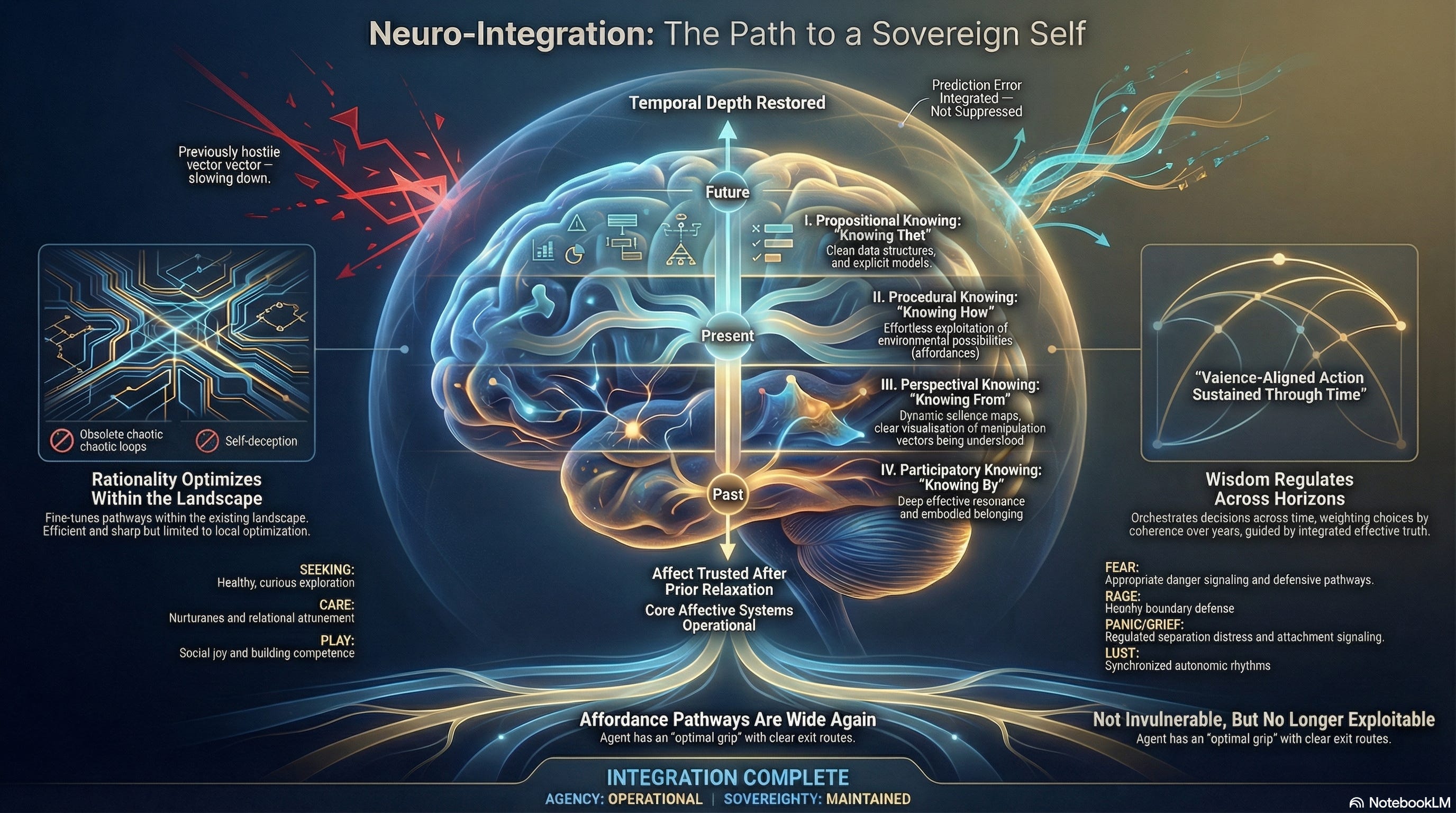
Module VII: Integration
Having gotten this far, you might say: “The enemy is legion, the battlefield is a mess, I forgot why I even signed up for this, and I might have lost a shoe somewhere!” I get it, it’s war, son, what do you want me to tell you? But there is some order in chaos. Or rather, there is always a way to bring some stability to entropy. So there is some cause for hope, which is found in rationality and wisdom. You might think I’m making an error here since “didn’t you just spend this entire selection talking about how cognition and meta-cognition weren’t enough?!” I’m glad you’ve been paying attention, and it’s one of the reasons you are one of the last ones who are left. Rationality has an alignment element to it, which is exactly what we’re diving into next. We’re taking the scenic route, though, so a slight detour first.
The 4 levels of knowing:
There are multiple ways to know. Many times, as I’ve been driving home, the intellectual capacity to understand isn’t the issue. And what makes things unrelatable, or not understood in some sense, is that you don’t have the experience, thus no affect to couple it to. Usually, the things that don’t resonate are the things we either haven’t felt or feel differently about (the opposite typically). And unrelatable is literally saying “my model doesn’t have that experience, as such, I can’t relate”. Which is why I want to highlight the 4 ways of knowing put forth by John Vervaeke, as we’ll rely on the concepts when we’re exploring rationality and wisdom, also a key part of the lecture series he has online.
Propositional
He explains it as “knowing that”, such as facts, propositions, and explicit beliefs. Essentially, what could be considered the surface-level, or the cognitive layer, since it maps onto the higher-order hierarchy of meta-cognition and imposing “chosen” belief. This would obviously be beneficial for getting the most out of what you have, and sets the stage for the ability for quick reasoning within current priors. Which we know is insufficient on its own since it fails to reach brainstem affective priors.
Procedural
This can be considered as “knowing how”, representing skills, habits, and embodied know-how. This obviously supports your local adaptation by exploiting attractors for action. Which we’ve seen as the exploitation phase, otherwise explained as your ability to competently “manipulate” the arena to get resources and needs met. Which is clearly limited by any unrelaxed priors, since “knowing better” procedurally doesn’t override trauma habits without relaxing those priors.
Perspectival
Explained as “knowing from”, which relies on salience, perspective, and what stands out as relevant. Which links to arousal coherence and prediction errors, since we needed both to learn and upgrade models. This is also a major factor that enables insight into the current landscape, spotting manipulation and your own capacity to bullshit yourself. However, it is constrained by a gatekeeping mechanism, since perspectival shifts need entropy/criticality (windows) to challenge deep attractors.
Participatory
This level of knowing is marked as “knowing by” , embodied fitting, and thus a relational being-in-the-world. This, as experience, directly forms affective priors via felt interaction, shapes models from critical periods onward. In our premise, this is the “emotional first” driver, with beliefs emerging from participatory valence (approach/avoid in 7 systems), and not from propositions. Which will be a crucial element to keep in mind for the exploration of both rationality and wisdom.
Rationality
Rationality’s function is essentially the scope of cognitive reasoning, which optimizes within the landscape’s current valleys, without challenging deep structure. It operates within the current landscape (local grip on affordances, or in other words, opportunities). Relying on explicit, cognitive knowing (facts/logic) for optimization, ignoring other modes. If we put it in the jacket of the 4 levels of knowing, rationality tweaks within current priors with its short-horizon, to exploit the existing attractor landscape via propositional/procedural tools. As such, it’s necessary for daily agency but insufficient, as we well understand by now, since it also creates bullshit (self-deception) when ignoring affective/participatory depth by meta-cognition imposing on brainstem priors without valence trust. The latter is your ability to trust that something is good for you.
Which is kind of ironic, that you become more rational by being able to trust your affects, since it is local optimization, which would mean that rationality is aligning cognition with emotional truth, instead of imposing on it. Since it can only work within the current attractor landscape, it speaks to why so many intelligent people get stuck and keep going in loops. Also, something that Antonio Damasio showed in Descartes ’ Error, since he outlined how, when the emotional structures were damaged, a person didnæt become better at decision making. Since the supposition is usually that emotions are “useless” or cannot be trusted. This also puts a serious dent in the fantasy of the “logicians” who dream of a Vulcan-like existence. For those who have no frame of reference, the Vulcans are a race in Star Trek who operate mainly logically and thus “cold”.
Much to my amusement when I share the outcome of Damasio’s finding, the person in question couldn’t make any decisions, since it had no driver behind it. To go into this a bit deeper, I’ve often used an analogy of a driver and a car for clients when it comes to explaining how biology reflects the capacity for your cognition. Consider poor biology a shitty beat-up car, and cognition would represent you, the driver. It wouldn’t matter how much I optimize the driver, he’s still driving a shitty car. Can he make the most of a shitty car? Sure. But that’s called surviving, not thriving. The same logic extends to affect. We can optimize your cognition and meta cognition all we want, so that you are the most amazing driver alive, but if I put you in a wreck that is prone to “spontaneously” combust, it’s only a small consolation that you are a great driver. So how on earth does aligning rationality with valence trust ever add up? clarify, it rarely does when you can’t feel properly (the entire rainbow of different forms of suppression), and or, your affective priors are, as we discussed, mainly negative affect.
There’s a very convergent “law” of Musashi that relates to this: Do not, under any circumstances, depend on a partial feeling. This dissonance of trusting emotions is easily solved in understanding that your priors have to be released in order to trust them at all. As we have seen, once those attractor landscapes flattens the bottom-up information can now start flowing back to the top. And very often, many people start integrating their emotions since the cognitive suppression is (temporarily) conquered or overridden. I’ve reflected on Mushasi’s quote endlessly, I actually have it tattooed on my arm as a testament to the profound core truth embedded in it. Since we will have partial feelings, moods, states, and the like.
Knowing which ones to trust and which you can’t isn’t a cognitive game of whack-a-mole. It is an emergent process from going through those interventions that relax priors, which allows the bottom-up information now to update your models. Hence, aligning behavior with what you “should do” and your “knowing better” all of a sudden becomes very natural. No mental gymnastics and wishful thinking required. It typically becomes very clear which affective priors you have been operating out of and how they have shaped your models of the world, model of self and your behavior in the world, and of course, your interactions with others. But this is an existential question, “Schrodinger’s emotion”, since you won’t know how that feels or what the difference is until those priors have been relaxed and the models updated. It’s been a point of discussion with many who are intellectual powerhouses, because they attempt to weaponize their cognition to attempt to make a point about trusting emotions when they haven’t experienced the profound change that comes with the entire affective experience changing and how that informs their models.
The irony, paradox, and frequently the tragedy is that what makes you adaptive makes you vulnerable. Even intelligence is included in this. Plenty of smart people, geniuses and intellectual powerhouses have been subject to parasitization or helplessness in the face of their deep affective priors. Smart or intelligent doesn’t mean rational or wise, it is only an affordance thereof. Especially since intelligence in cognitive science, and perhaps even in evolutionary biology, means the capacity and ability to problem solve. The more intelligent, the more of the problem space it can see and solve. However, the more intelligent you are, the more this double-edged blade cuts you since you’ll most likely be an expert at bullshitting yourself. Trust me, I see it all the time. So if rationality optimized the local landscape, what would that mean for wisdom?
Wisdom
In the case of wisdom, this is where the real wizardry surfaces. Since it isn’t just about local optimization, but long-term alignment. The joy of the exploration isn’t over, since we have to take a look at a concept that will provide clarity on the topic. The paper we are leveraging is Temporal depth in a coherent self and in depersonalization: theoretical model. A part of the premise is based on dissociation and depersonalization, especially in reaction to chronic childhood abuse and neglect, which is obviously very aligned with what we’ve explored since these are the affective priors we’ve covered. Since we’re involving the time element, my favorite type of wizardry in relation to identity and behavior, that’s what they refer to as temporal depth.
They start with stating that they see the self as a process in time and a coherent linkage of the self through time is related to the core concept of our paper (hence why I invoked it). The “temporal depth” which represents how far into the future the agent can plan and how far from the past it can recall. A collapse of the temporal depth may lead an agent to living in the “here and now” accompanied by the inability to access knowledge of the past or plan for the future. The last part is the hedonism bastardization of the premise of carpe diem (which had nothing to do with hedonism by the way, but an urgency to live). Addicts suffer immensely from a collapse of temporal depth, since they want it right now, regardless of any of the consequences. Which is something that has touched me personally since I lost a client dealing with addiction. It’s easy to tell someone with any style of addiction or tendencies towards being relational or wise in the moment, but it would fully discount the overtaking of their mesolimbic reward circuits.
My former client and I talked about this extensively, and he shared with me how his addiction felt like a literal possession. The parasitized SEEKING system assumes direct control over the motor cortex, and “he” was no more. You see the link here, that’s a temporal depth collapse, access to other faculties, even memory has been revoked. Rationality has left the building. But even more pressing, is that the Self as an agent has left the building. Since there is this uncoupling of the temporal depth with its memory factors. Which is the point they make later on. Healthy individuals are able to temporarily expand or contract temporal depth voluntarily to some degree through attentional control. Temporal depth expands during long term planning, and is contracted during attention-demand tasks, like in Flow states, where successful performance is generally not self-conscious. During the voluntary collapse of the temporal depth, an individual may experience a healthy hyper-focused state of “losing oneself”. All just to point out that the mechanism itself is neutral, but that its expression will depend on the person.
This paper has a lot more gems and implications for what we are exploring here, but I will save that for another book. So when we put these concepts and parameters together, wisdom is the ability to regulate across horizons via integrated affective truth. Which isn’t imposing cognitive ideals, rather it’s about trusting the updates that “feel” right (positive valence from windows like love/curiosity/therapy), allowing bottom-up reweighting to settle new attractors. In our premise, it clearly highlights and integrates the cognitive-affective split which we’ve focused on extensively. As wisdom aligns meta-cognition with emotional reality (updated priors from participatory experiences), achieving agency (psy-op resistance) and authentic self-expression. It’s forged through repeated valence-positive iterations (integration post-collapse), not one-off insights, hence the “long-horizon”. Because that clearly takes some real work across a considerable time frame.
Wisdom navigates this extended temporal depth by participating in valence-charged reality (windows like love/curiosity/flow), realizing relevance (what feels meaningfully true), and integrating affective truth across horizons. So in the end, it’s not imposing cognition, it’s about aligning with the participatory flow for agentic adaptation (the things that make you feel more you). In my work with clients, I’ve adopted Paul Conti’s term called generative drive. Which is essentially this ability to recognize, orient and execute on those aspects that feel right to you. This is a key part of self-trust, since our affective models drive cognitive ones, changing those attractor landscapes lends to a better interpretation of all these models. Hence, wisdom is trusting valence-aligned updates, because only you can feel what is right for you. And I don’t mean pleasurable in a hedonistic sense, I mean right across your hierarchy of beliefs and values. We could argue that this is partially where rationality and wisdom converge: not imposing cognitive beliefs, but cultivating awareness to trust and integrate the affective ones that actually run the show.
Reading and understanding are just a small part of the process, since the real transformation happens in the process of these interventions, and the “post prior relaxing” integration phase. So when it comes to understanding at the participatory level, or the experiential domain, it is largely why we don’t believe people when it comes to the mystical, spiritual, religious, or anything else. If I had announced that God had tasked me to write this and spread the message, your first instinct isn’t to drape me in a purple cloak and call me a herald of the divine. I understand this was different in ancient times, but even for the ancient Greeks, this came with some measure of skepticism.
The underlying principle of not taking someone’s experience as gospel is the premise for and actual point of Plato’s allegory of the cave. For some bizarre reason, people only use half of the allegory, indicating a “higher realm” or different reality, absolutely missing the most crucial point: the philosopher returning to the cave to tell the people about his experiences. Which is the central core of what we’ve been talking about, how can I, with a proposition, give you that experience? I can’t, it’s nigh impossible. That’s like trying to explain the sun to a blind person raised underground, which is close to the metaphor Plato uses, since the people in the cave are experientially blind. The participatory level is the experience, it is a felt reality, which is what makes those models in the first place, as we have seen in the premise of active interference and the FEP. Models of the world are formed by interacting with, experiencing it, and participating in it. In the information theory frame, information you aren’t privy to and can’t see can’t make its way into the model.
Hence me often returning to acknowledging the limitations of this entire piece as a propositional exposition, which, truth be told, I care little about, since my main intention is to get you to act towards addressing your priors by doing the modality that fits the most for you and your circumstances and needs. My only propositional hope is that I’ve done a good job cultivating a reader base with high levels of agency and a desire to plunge into the depths of their own attractor landscape. This is also the irony I have to work with constantly as a coach who flies in on location to spend a month with a client. I can explain most of this quite decently, but that doesn’t allow you to experience the coaching. And I don’t mean flying to Bali and spending time there. But the actuarial effect of coaching, of doing the mapping and exploration of their neuropsychology, of digging through the unconscious into their attachment wounds, or the changes they feel when we’re following the applied neuropsychology protocols of their nutrition, supplements and everything else that comes with it.
My propositions might pique your interest, but you didn’t experience anything. People catch glimpses of my coaching abilities when I just explore things with them. It is largely superficial, since the experience of coaching follows the principle of therapeutics we talked about before. I can give you grand theories on coaching, but that’s not an experience of coaching. And those glimpses are but glimpses, they can never capture the total surrender to the process.
Assumptions regularly rely on the projection of a model and its priors, non-emotional, in the cognitive realm. Which we could argue is a big stumbling block, or an actual emotional blockade that stops affective relating. Something I already broached with the lack of resonance and relatability, since you aren’t aligning models of the world, rather “forcing” your model onto someone else. This model misalignment and misconceptualization form the foundation for miscommunication in general, since one or both parties involved presume to know what the other is talking about but don’t. In terms of attachment, shared experiences mean shared conceptual models and enhanced neural coupling, interpersonal synchrony. And shared experience is exactly how we relate in the first place, which tells us something about the primacy of these models. And why I spent the amount of time and effort into making you the special forces equivalent of understanding how these models work in the first place. That being said, I think my job might be almost done here. So let’s recap the core premise and get ready to crack a cold one.
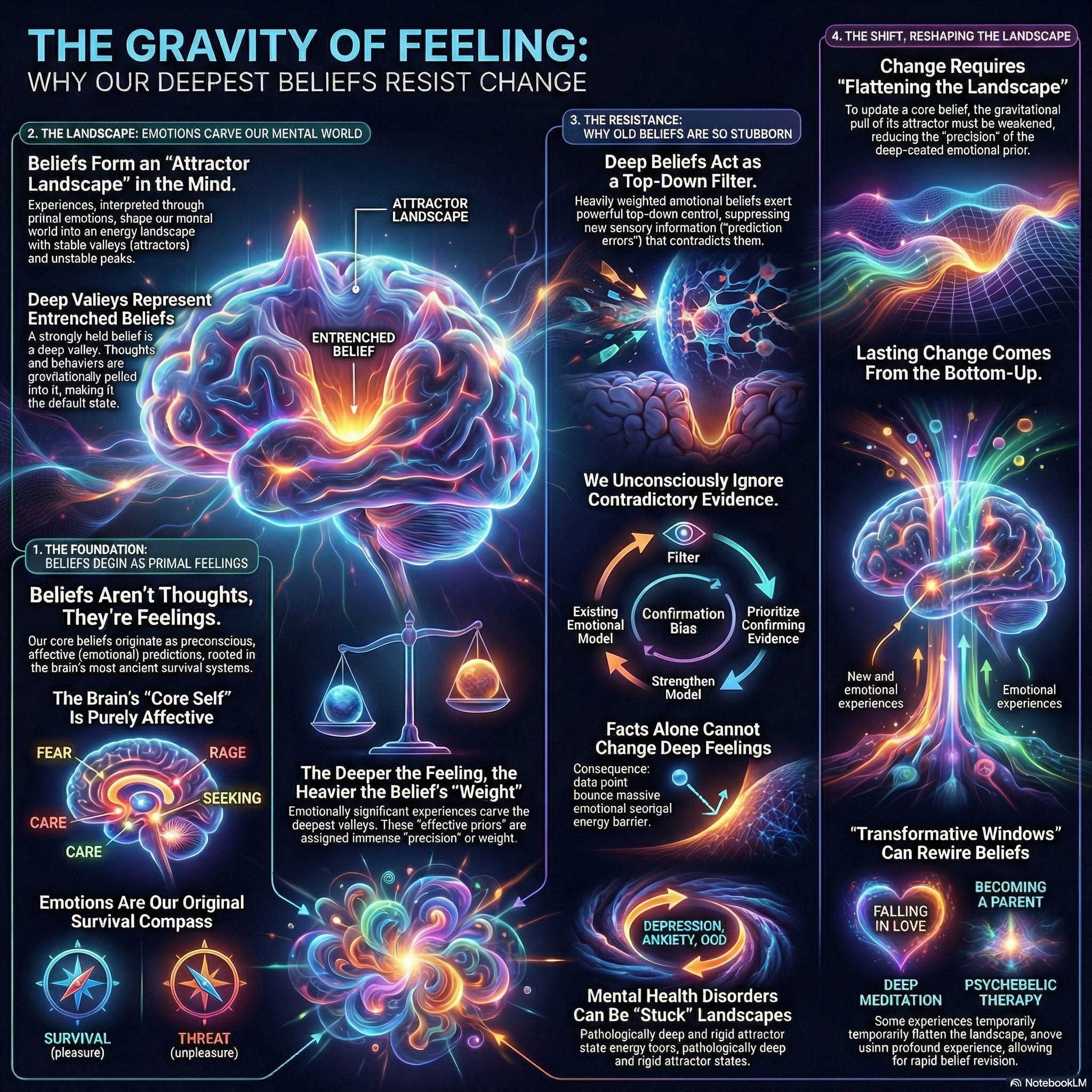
Summary
You’ve made it to the debrief, and what a journey it has been. If you manage to get straight A’s here, you’re in. So don’t falter now, and stop worrying about your shoe. Rather than a complete recap, we’ll do what I refer to as “gisting”. Effectively summarizing the gist of it, we’ll still have to bring back some of the technical terms, but we won’t be doing the same heavy lifting. We’ll stick to the core premise
Beliefs as embodied/affective from interaction
Your beliefs are clearly centered, generated, and stored by your experiences, whether you are conscious of them or not. A great example of this was a story that features in Mark Solms’ book The Hidden Spring. In it, he relays that there was a female patient who had no short-term memory recall, and thus the ability to form long-term memories was disrupted. To test if she could still learn in some way, the doctor who was treating her hid a tiny pin in his hand when he went to shake her hand. Despite the lack of memory consolidation (storage and recall) she refused the doctor’s hand next time they met, but couldn’t explain why, and resorted to a defense narrative. If you needed any more proof to understand just how much is driven by affect, here it is, and it drives the point home. It puts a bit of a dent in choosing your beliefs, most of them are chosen for them in your critical periods.
I want to bring back one of the most memorable lines: “Our biological needs cannot be met narcissistically, by mere feeling of reward versus actual achievement of reward.” Not just because of the implication of attachment, but because they talk about it in the sense of your interaction with the world. The very “thing” which creates these models in the first place. I wanted to highlight this because there is an often perpetuated paradigm that by invoking the feeling internally, it is the same as if it had happened in the external world, and would even potentially help you “attract” this into your life. Not to say states don’t have an attractive quality to them, since happier and more pleasant people get more opportunities, typically than the introverted or depressed. However, it’s clear that your invoked feeling and the feeling from successfully meeting a need are miles apart. A sexual fantasy, despite the feelings it evokes, isn’t the same as actually having sex with someone you like.
The concept extrapolates across the board. Especially since we know these priors of our affective needs also have weight, and thus, you will revert back to baseline, like a rock rolling down a hill into the deep valley when it has been dislodged. The only thing this type of emotional bypassing does is provide temporary relief, which is a small consolation, if at all, when it doesn’t lead to a meaningful change in behavior. The priors are where it’s at. Which leads us to the following.
It stands to reason that emotional priors are difficult to update by design. The need for stability is a big driver for this, and the brain works at different speeds for changes to make sure there is coherence and stability. Especially when the brain relies on some levels of integration. If those deep layers moved at the same speed as the superficial layers, then you wouldn’t be able to form a coherent conception of self. There won’t be much of you to speak of in the first place. Since that’s largely what the paper on temporal depth was alluding to. Your affect is part of the core self, and updating the core self is protected from access and updates for the sake of stability. Or put in the Free energy principle premise: to minimize free energy and minimize uncertainty. They make a convergent note of this in the temporal depth paper by stating that Friston wrote extensively on temporal depth being a necessary component of underlying self-consciousness. We can’t have a core self, and an extended integrated self without temporal depth, and affect, since consciousness is rooted in the brainstem, with our 7 emotional systems forming the basis for both consciousness and our personality. It’s obviously not impossible to change, but expect that it will require more than wishful thinking and mantras.
It’s layers all the way down
I’ve often told clients and friends that the psyche is layered, clearly biology is innately layered, so how could the psyche not be layered? Psychology still has to follow the fundamental principles afterall. Which is what our exploration clarified, and the principle of Markov blankets so elegantly illustrates. My main aha moment came from two experiences. First, the amount of cycling I’ve experienced between various states, which is a test of my sanity since it demands a high level of self-understanding and centering not to get caught in the cycles. And, every time I reached a new layer, or released a layer, my initial response was “this is it!”, it was not it, it was just the next stage, phase or layer. That doesn’t make the experience less significant, but it does take away the finality from it, since it is a dynamic process, and a multilayered one. In my next book, The Intuitive Self, I will build the case for the degrees to which these layers exist within individuals, because it’s not like everyone has the same number of layers or the same degree of access or availability.
Given that I had accessed so many layers, and layers kept coming, it dawned on me that my neurological complexity was much higher than I gave it credit for or even thought was “possible”. A manifestation thereof is represented in this book, but that’s just one angle. The main point is to convey just how layered it can be, and that access to layers is also highly dynamic, as we see with windows of opportunity in terms of openness, willingness and curiosity, which are all driven by the individual degrees to which a person has the biological parameters for them. And why I outlined that the intervention will change depending on the layer you are trying to tap into. And even when you get to the deepest layer, deep inside the brainstem, that attractor landscape is still extensive, and is rarely resolved in a single go.
Encroachment on agency, personhood, or selfhood and the expression thereof feels bad.
I can’t think of any living thing that likes to have its affordances constrained, when it comes to their homeostatic needs, which is, as we’ve seen for us and other mammals are also affective. Which speaks to the biological basis of why it feels bad when someone tries to “keep you small”, or push, force, manipulate, or anything along those lines away from what is right or true for you. Especially when it relates to affect, since as we‘ve seen, that is the only way to know what is right for us at a core level, or at the core level of the Self. It’s typical, or at least common, that in trauma-informed models there seem to be two main expressions around that encroachment, that is, people pleasing, since suppression has been learned as the adaptive survival mechanism, or violence, since the only resort that is left is to attack the threat that has been attempting to keep you down.
The way your attachment injury happens, plus your own dispositions, and other factors, will determine which way you lean. This forms the base of why it is so hard to “come back to your true (or core) self”. Since you’ve either been conditioned into surrendering your needs, and to suppression the authentic the expression of both needs and your personality, or (and) your cognition and meta cognition are tasked to do overtime why you are suppressing these, and to align your rational faculties with your affective priors (hence rationalizing or attempting to explain away your own behaviors of those the people you love that are hurting you).
Another factor to look at is that in the natural world, epistemic competence is rewarded by resources and further opportunity, now considered status (and/or money). When this is “taken away” from you, made inaccessible, or otherwise deterred from, that is a significant driver to feeling bad. It extends to suppression of agency, as your ability to act in the arena (environment) is the expression of agency. This reminds me of a great quote by the Stoic philosopher Epictetus, who drives this sentiment home: “If a person gave your body to any stranger he met on his way, you would certainly be angry. And do you feel no shame in handing over your own mind to be confused and mystified by anyone who happens to verbally attack you?” I’d imagine you do feel some anger, and that is the point, isn’t it? Since it would allow you to fend off the attack, the encroachment on what is yours.
Mission accomplished, Soldier, you survived the selection process. Claim your insignia patch of the CIOD.

Conclusion
Congratulations, you graduated, hell, you’re the only one left in the class. Consider this the motto and keys to cognitive integrity, and being psy- op proof:
1. Know thyself
2. Heal thyself
3. Attach thyself
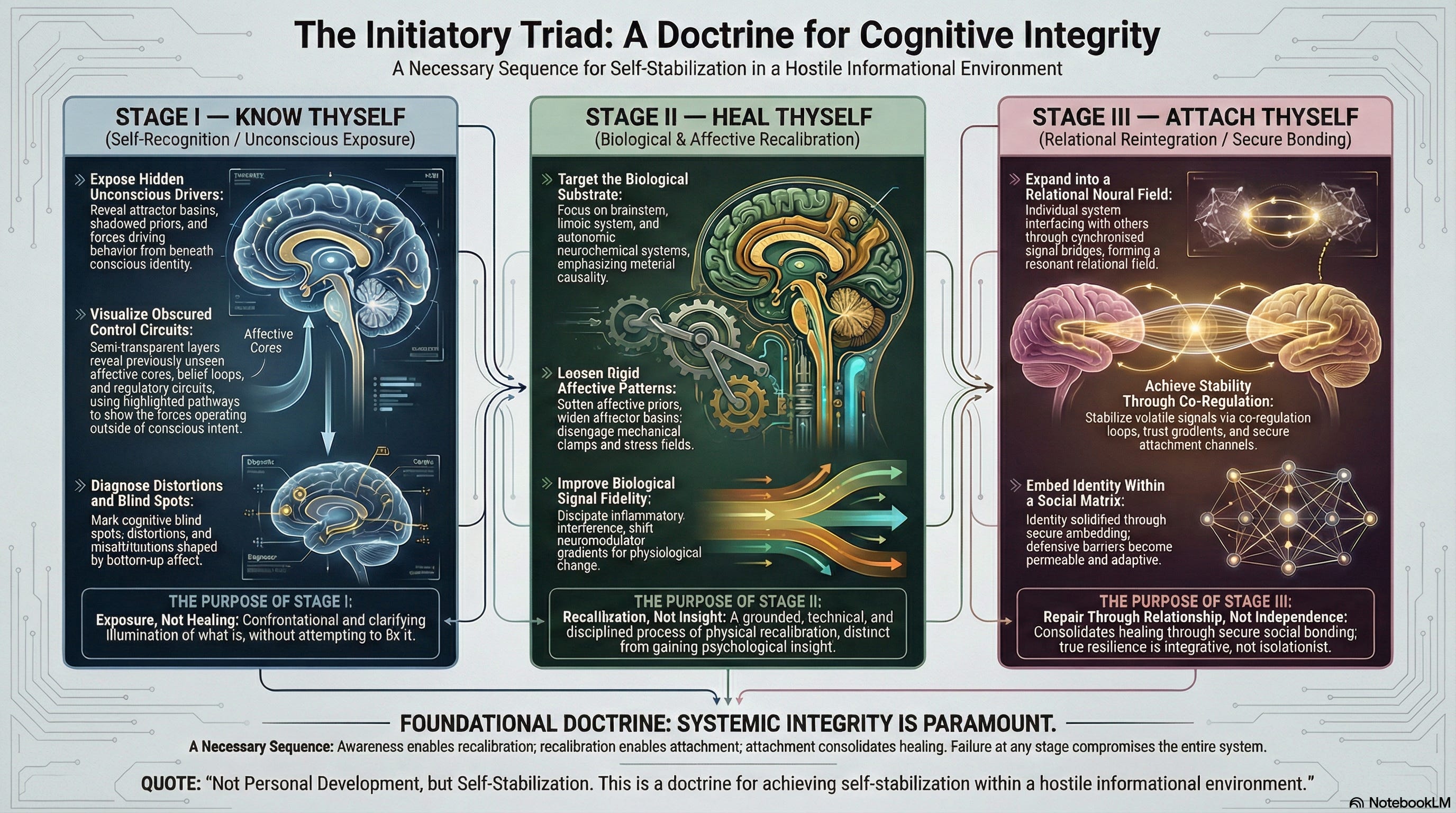
Know Thyself
Saving the best for last, which is philosophy in essence, since this is how we return to the root of things. There’s a reason why this ancient Delphic description echoes into the future thousands of years later. Because when you unpack, it shows how elegantly it compresses something universal and fundamental. Understanding yourself sets the stage for everything else. Jung argued a similar case about making the unconscious, the things we weren’t aware were calling the shots, conscious. Which is Freudian in its nature, to give credit where credit is due, since Freud could be considered the godfather of neuropsychology, and intended to create a neuropsychoanalytic system, but didn’t have the technology needed to make it happen. History lesson aside, the point remains the same: understanding what is driving you is necessary. Insufficient, since we covered that priors need to be relaxed and neurobiology needs to be addressed, and then integration in the local ontology and its social matrix is the last key.
In terms of deep self-understanding, I recently published my model for thai which you can read here:
It will form the premise for the main and ultimate book I am writing on the neuropsychology of the self.
Heal Thyself
Considering everything we researched, I don’t mean this in the stereotypical psycho babble way. I mean this at a profound level of relaxing those priors through the various interventions. It has to be abundantly clear that this isn’t a cognitive process. Psychology is in function of biology and neurology. A tiny change in some of these mechanisms has a gigantic implication, like those gene alterations in any of the neuromodulators we explored, and all the others we didn’t explore in depth. Which is why I keep hammering on people’s biology, incessantly, to the point of making them exasperated. If you don’t know where to begin, run functional medicine tests, and get a practitioner or a coach.
Attach Thyself
A big part of “psy-op” proofing is socialization, and focusing on the local ontology. Jonathan Sedler, the psychologist, has an amazing quote about this: “Our sense of self develops in relationships. What gets broken in a relationship must be repaired in a relationship. You can get what you can get from reading, studying, and reflection. I highly recommend it. But it is in no way a substitute for a meaningful psychotherapy relationship.”
I would just switch out to say a therapeutic relationship, given the constraints we have talked about in the therapy section. The biggest impediment to healing is the emotional and often spiritual bypassing that people resort to, which is a very logical way to avoid response of those negative affect priors in terms of attachment. There’s an expression of that with “self-reliance”, since when you are on your own, those deep affective priors don’t get triggered, it gives the illusion of resolve. Taking the trigger away, not having deep, vulnerable bonds, doesn’t mean those affective priors are resolved. Why would they be? That’s akin to “If I can’t see them, they can’t see me” by closing your eyes. You can release your priors “on your own” (through the interventions), but that’s not healing, healing happens when the affect, hedonics, valence, identity and behavioral responses change. To what degree one can change is a completely different matter. Though reintegration into the social matrix and re-attaching securely are the most important aspects of healing. Outside of releasing those affective priors, I’d recommend reading The Attachment Compass. And I can share that I will be rewriting it partially to accommodate the principles we explored here for the Extended Edition.

Extended Edition cover.
Since I’ve mentioned my books a few times in the process, if you want to read more than what is available to read for free here on Substack, or if you want a physical copy, you can get them on Amazon. All of the books follow a similar approach to how the exploration takes place, as we saw here. The main difference would be the scope, theme, and that there is way more philosophy involved.
Well, that’s it, you are now dismissed, and you can join your unit to become a full-fledged operator in the Cognitive Integrity Operations Detachment. It was a pleasure being your instructor. Fall out.
Resources
Temporal depth in a coherent self and in depersonalization: theoretical model
Self-organization, free energy minimization, and optimal grip on a field of affordances
It’s not the thought that counts: Allostasis at the core of brain function - ScienceDirect
The Hard Problem of Consciousness and the Free Energy Principle
Primary Emotional Systems and Personality: An Evolutionary Perspective
The war inside your mind: unprotected brain battlefields and neuro-vulnerability
[2505.22749] Self-orthogonalizing attractor neural networks emerging from the free energy principle
The Hidden Spring - Mark Solms
This article comes at the perfect time. Your "emotional first, cognitive second" premise about beliefs is so sharp. It really explains so much about human behavoir, especially on-line. A fantastic mission statement for smashing those old paradigms.