
Spring Reflections 2026
Assorted Notes On Recent Topics


The idea of the “seasonal” reflections has less to do with the seasons themselves and more with the period in which these reflections have been produced. The shorter posts often get lost in the noise, even for me, when I use them as references and stepping stones for the essays I write and, by extension, the books I am writing. In a sense, they also both presage what is to come, and “encapsulate” what I have already written as a sort of summary. They thus often hit on the themes I am working with and reflecting on, these reflections are born from my experiences and interactions, rather than pure reflections on the material. Since I coach, I often ask myself how all of these themes or topics, show up in my life, and what that means for my behavioral patterns and behavioral drives. That also makes these writings more raw, unpolished or unrefined, at least at times. Other times, they capture the exact flow of the moment, the sentiment, the very thing I was thinking right there and then, even expressed in poetry. There is no real structure here or logical flow. I’ve grouped them somewhat to represent the theme and extensions thereof I had in mind.

TRUE LACK
What is True LACK?
The most grounded perspective of lack is presented here by @Peter2010531850
The premise of lack is usually dressed up in pseudo and pop psychology, or directionally correct psychology. And even when trauma psychology is correct in its essence, the mechanistic grounding is often lacking.
Why does this matter? Since this can “sound” as if it’s just about semantics. It matters because it gives a proper answer to why such, significant variance exists, and why attempting to “fill the void” with materialism and mental gymnastics and addiction does not work.
If we put Christophe-Peter’s work, and his sources together with findings from Panksepp and Solms papers (these are also his sources, I’m emphasizing a specific paper), “Affective neuroscientific and neuropsychoanalytic approaches to two intractable psychiatric problems: Why depression feels so bad and what addicts really want”. We can trace the origins of these feelings and this experience pretty clearly.
This nullifies a lot of the new age spiritual and pop psychology approaches and perception of abundance. Since these do little, and have the potential to both increase confusion and do more damage to the co-identification -> belief -> narrative -> perception cycle, because it is attempting to “solve the problem” from the wrong level (as usual).
As a side note, there is some “odd” resistance to science in this sense from the aforementioned fields and their demographics. And although some science skepticism is warranted, I get the feeling it is because they have no clue what they are talking about and proper affective-genetic neuroscience essentially exposes, disrupts, and largely makes obsolete their narrative structure.
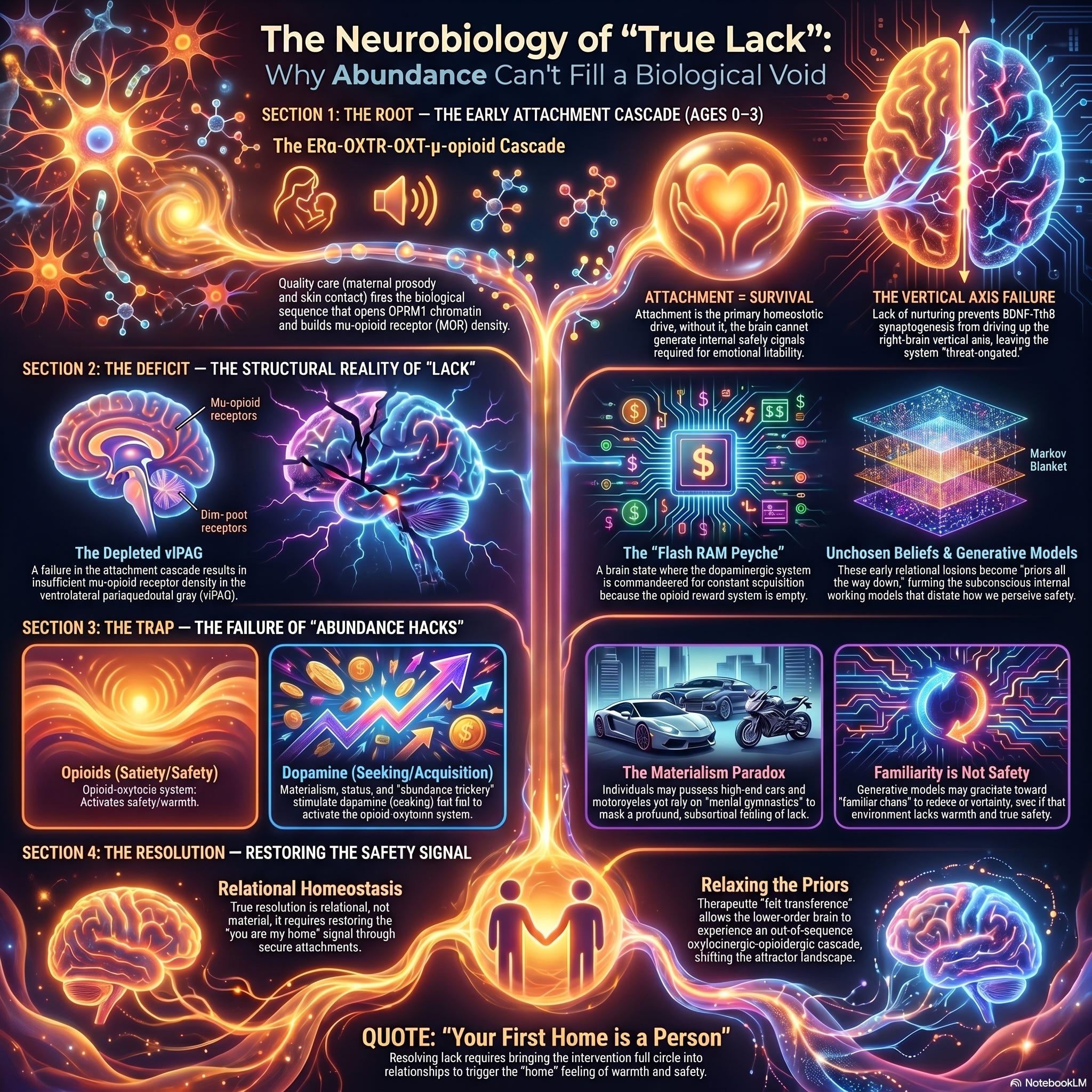
There is a critical failure to understand “abundance” when it is not based in/ on the primary homeostatic drive to survive. Which in its primary sense, beyond the other homeostatic biological aspects, is attachment. So the fatal flaw is already found when attachment is not a part of abundance, or even more so, when it is not the centerpiece and focal point. Attachment = survival. As long as the opioid mediated safety signal cannot emerge, especially where it matters, you will keep experiencing true lack, no matter how much abundance trickery you try to pull.
So here we come to the crux of the matter, Christophe Peter’s work and synthesis:
Christopher-Peter grounds “true lack” in the brain opioid theory of social attachment (Panksepp) integrated with Balint’s “basic fault” and the early (0–3) attachment cascade. When quality CARE, that is, the maternal prosody, skin-to-skin contact, and attuned responsiveness, is absent or disrupted, the ERα-OXTR-OXT-μ-opioid cascade never properly fires. This fails to open OPRM1 chromatin, build sufficient mu-opioid receptor (MOR) density in the ventrolateral periaqueductal gray (vlPAG), and drive BDNF-TrkB synaptogenesis up the right-brain vertical axis.
The result is a foundational homeostatic deficit: no opioid-mediated safety signal, no felt warmth, no “home” in another person. The system stays threat-ungated and MOR-depleted. What emerges is what he calls “Flash RAM Psyche”, which is a dopaminergically commandeered, skittish, acquisition-driven brain sitting atop an empty opioid reward system. Positive affect, affiliative range, and the ability to feel relational reward are simply not wired in, or rather, extremely disrupted and dysfunctional.
Often, I come back to this idea of the priors’ priors, or “priors all the way down, “ the very first internal working models (Ainsworth) or generative models are affectively anchored in these opioid-oxytocin dynamics. And the picture gets clearer as we extend the thinking of the opioid genes to oxytocin, vasopressin, dopamine, serotonin, etc. And in a sense, the all-the-way-down principle extends to generative models, especially as it relates to Markov blankets and the layers of informational flow (Unchosen Beliefs + Hidden States for more on this).
Balint’s basic fault seems abstract, but in essence, it is this early relational lesion. Even in adulthood, the rare moment of “felt transference” is the first time the lower-order brain experiences an oxytocinergic-opioidergic cascade with a person they feel truly safe and loved by. The adult mind encounters an out-of-sequence bodily feeling of safety from below and has to reinterpret it, this is exactly the point where priors can begin to relax and the attractor landscape can shift. Hence, true lack is not semantic, not spiritual, and not solvable by abundance hacks.
It is a primary homeostatic failure in the attachment circuit itself. Materialism, status, bought company, or mental gymnastics only feed the dopaminergic layer while the opioid safety signal remains absent. It is the height of irony that this is rarely understood and even less applied. This speaks to the immense divide we still need to cross in getting the right information out there, with a framing that is intentional and grounded rather than the pseudo-pop psychology babble.
This is why a person can feel like home, since it has everything to do with feeling warm and safe (opioid-oxytocin). And if you think about it, your first home is a person. Which is why that “feature” or expression keeps re-emerging, especially in secure attachments, where they find their significant other to feel like home. That’s why, in the final analysis, resolving lack is relational. Whatever you do, intervention-wise or therapy-wise, the idea is to bring it full circle into your attachments/relationships.
Since we return to the core there, that home feeling, true safety, true abundance, is then deeply emotional. Imagine what happens in the womb, the first home, when you’re either not wanted or it is “inhospitable” (high levels of cortisol, dynorphin, lack of oxytocin, etc.). And then, what we end up chasing through various other means, copes, crutches and compensations. The factor of epigenetic change was something I encountered in the book, The Brain That Changes Itself. They highlight the change of epigenetics in therapeutic settings, something I’ve experienced firsthand with my clients through coaching, so I am not understating the obvious and important benefits of this. It’s just that this is rarely enough, with such entrenched and rigid priors and an attractor landscape. That’s why I wrote about the various interventions in Unchosen beliefs that deal with relaxing priors and collapsing the attractor landscape.
The attachment circuit and neurobiology then extend into everything else, since a place can feel like home too. And this is where the classic error happens of trying to “out abundance” this lack. Especially with money, status, materialism, bought company, and so forth. And why these people, in the midst of financial and resource abundance, still experience a profound lack. In contrast, others can feel plentiful with virtually no money, few resources, or material possessions ( I am not saying this is a virtue, or that being poor is a virtue, just drawing the conclusions).
Shortly before one of my clients passed away, he confided in me that he would have traded all his family’s wealth for the type of relationship/attachments that I have with my family. If that doesn’t tell you something. That’s why we can’t circumvent attachment, and its homeostatic quality (as in trying to maintain and get to a preferred state). Hence, the only real resolution is relational, restoring the opioid-mediated “you are my home” signal that attachment was always meant to deliver, rather than the myriad of tail-chasing avenues.
Important to distinguish familiarity from home in terms of safety and warmth, this is where generative models get to shine, since they are our unconscious beliefs, pre-conscious - subconscious models, which you gravitate towards since familiarity reduces uncertainty, and this is a core feature of biology. Hence, they need to be differentiated, since the familiar can be pure chaos and volatility, which is neither safe nor warm. This is a common and often difficult split to place for people since they rarely get the generative model aspect and how it attempts to make the external world fit its internal world (the model), much to its own detriment.
And as I outlined in both Unchosen Beliefs and Hidden States, and largely why self-sabotage emerges. The model must be adhered to, and thus the cycle continues.
Check out his work on his profile, it’s worth the time.
As far as the exploration of all of this, it is going to be properly worked out in the Extended Edition of The Attachment Compass, where Christopher-Peter’s addition will have a beautiful place. The last essay series walks us partly through this. Unchosen Beliefs -> Borrowed Convictions -> Hidden States, which also completes the bridge into the Extended Edition.
Part 2:
True lack exemplified:
Here’s a great example/illustration of exactly what I’ve been talking about in this post:
One of my buddies has:
2 motorcycles, one of them is a brand new superbike.
2 cars.
And when we talk, he still relies on all of these mental gymnastics in terms of narratives and borrowed convictions, cognitively chosen beliefs to make up for this LACK, especially when they relate to his co-identifications.
All of it is just a more complex form of escapism, bypassing and denial of reality, especially when it relates to their identity complex. Another dead giveaway is that they have a tendency to make this struggle/process into a virtue, or even more extreme, into some type of heroism. And anything they “gain” in a materialistic sense becomes a confirmation bias of all of the above.
The sophistry gets more complex instead of resolving those deep subcortical priors. Which is why I’ve used a black hole or a “drain” they circle, something they can kind of infer the outlines of, but can’t identify because it is “hidden” by layers of complexification of the brain and their models.
Which is partially why I, as ironic as it sounds, dislike talking about all of this, since the proposition doesn’t relax the priors or collapse the attractor landscape, talking doesn’t change their subcortical priors, and belief states. So it doesn’t matter if I took a hammer or a scalpel to them, when the fortification, solification, rigidification, or calcification is so strong, and they cling to their sophistry like a lifeline.
Which in a technical sense, it is a lifeline, since it is there to keep their construct of self, their identity complex, stable. I see the “Flash RAM psyche” competing against the abyss of their lack, in a futile attempt to stay away from the void. In that sense, most of their models, if not all of them, are compensatory for that lack. There is an implicit silent cry to it all “love me, accept me, validate, choose me, see me, hear me”. The PANIC/GRIEF system is still scanning for the missing relational opioid cascade, and is only met with silence.
So if it is met with silence, it will resort to screaming by an attempt to make their presence, or rather their status and physical stature, undeniable, which has an intuitive “ick” repulsive or aversive “color” to it. So it leans into the: if I can’t get positive attention in the way I need, I will get “negative” attention (or forced attention) in the way I want. That is to say, the keen and intuitive will spot the performative nature of it all, because it is loud, boastful, convincing, attention demanding.
If you want to put it in the framing of the DMM, it is a dominance of Type C, protest policies, that is coercive policies ar the behavioras which aren't not coming from secure affiliative reward; rather, they come from an empty opioid system trying to force the attention it never wired in.
What do those strategies or policies look like? Coercive, dramatic, attention-demanding, and emotionally manipulative. Since, in volatile or inconsistent caregiving environments, the child learns that quiet need gets ignored, but amplified protest (anger, seduction, helplessness, grandiosity) gets at least some response. The generative model encodes this as a high-precision prior: “My safety depends on making my presence undeniable.” Which obviously they take into adulthood, and could they otherwise? As what you have subcortically just complexifies cortically, which is the point I made above. So now the same policy scales up into the Flash RAM version that Christopher-Peter coined, which expresses itself as status, motorcycles, BMWs, narrative sophistry, all functioning as adult protest behaviors to keep the PANIC/GRIEF system from falling into the void.
In essence, the system never learned the quiet, opioid-mediated “you are my home” signal, so it defaults to the loud, coercive alternative. Despite, ironically, their verbal insistence that this is not the case, but again, of course, they would resist any allusion to the fact it is compensatory. As their attractors calcify, the identity complex becomes a fortress built on top of the screaming PANIC/GRIEF circuit. Which returns us to the crux of why propositions (even good ones) bounce off because they never reach the subcortical level where the real pain lives. The True LACK is quasi-impossible to change, let alone resolve, through your inference, that is, understanding and realization. The resolve is in relaxing priors, layer by layer, since the entire attractor landscape has a tendency to resist full disruption.
The Architecture Of Attachment
The persistent issue with attachment theory is that it is seen as a cognitive construct when it really is primarily an emotional construct, that is, an affective generative model at the same level from which consciousness is generated (largely subcortical).
Which is why understanding attachment theory cognitively is not enough, necessary but insufficient.
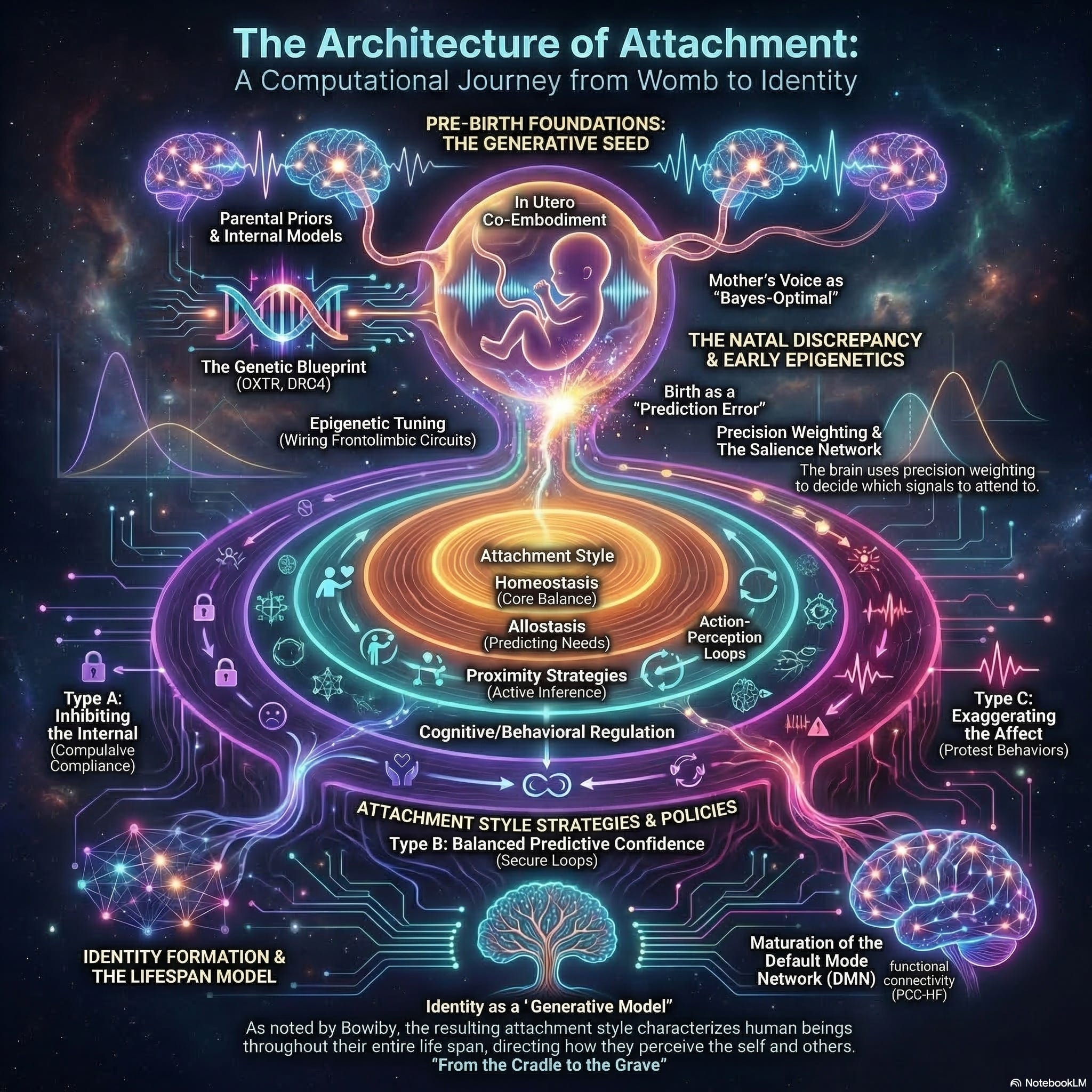
Here’s the timeline and architecture of attachment:
Parents and their attachment models, before the child is born -> their genes -> in utero/Natal, genetics & epigenetics -> early childhood and epigenetics -> attachment "style" strategies and policies -> identity formation.
Very often, when people try to resolve aspects of their attachment, especially if they use cognitive top-down only strategies, they rarely get very far. It’s kind of like people are circling this gravity well that keeps pulling them in, that they resist to some sense, but can’t understand what it is that’s pulling them in. The paradox is that you can infer that there is a gravity well sucking you in, but that inference alone doesn’t resolve it. And there’s a good reason for this.
The reason you can sense the pull but not escape it is structural: the brain's architecture enforces separation between layers via Markov blankets. This is because Markov blankets, which are information layers that only pass on certain information, are necessitated by the architecture of the brain itself. So you’re always dealing with “hidden states” and thus hidden information. Hence, the “hidden gravity well” is the affective generative model of attachment and self, since they build each other. This means layers of information have to be crossed, but in order to do that, you need something other than cognition, that is, bottom-up interventions. This doesn’t mean you can’t understand that these issues stem from your attachment, but rather that understanding this cognitively doesn’t change the emotional priors.
That’s why priors need to be relaxed, which allows the attractor state and landscape to collapse, which means that the information state between this hierarchy of nested Markov blankets changes, and all of a sudden, all this bottom-up information from the subcortical areas can flow up into the higher-order cortical layers, finally making it into the cognition engine. Which has a far higher probability of occurring with other strategies that disrupt the usual neural landscape. Especially the more rigid the priors, the more intense the intervention needs to be. Once the priors are more relaxed and the system has increased plasticity, that’s where less intense bottom-up interventions can be helpful, and eventually, cognitive interventions will succeed where they previously could not.
This also means that the hierarchy of Markov blankets is reflected and converges on the hierarchy of beliefs and the hierarchy of needs. Which is why it is hardly ever as simple as changing a single belief or addressing a single layer, prior, or attractor state. Which is why I used the term attractor landscape, since it reflects the complexity of these various priors, belief states, and thus attractor states. The deeper you go down that hierarchy, the closer you come to the root of the deep generative models in the affective subcortical regions of the brain. Since all of it is based on emotion to begin with. This complexity is then also reflected in attachment behaviors.
This speaks to why attachment styles alone, especially in their usual pop psychology format, are suboptimal. Since there are mixed patterns and behaviors, as seen with the Dynamic Maturation Model (DMM), meaning that people use a mix of strategies and policies for their attachment needs. It forms a very grounded counter to the pop psychology view of attachment styles as these rigid concepts that people tend to co-identify with. The pop psychology versions leave little to no room for context in terms of how and when your policies and strategies express themselves and change according to context. As an example, you could be a good friend, but still be “completely hopeless” in a romantic relationship, precisely because the stakes are higher and it hits straight to the core of attachment. The point is that although there are general patterns to attachment strategies and policies, there are also specific patterns (people, places, etc).
You can’t cognitively override the desire for attachment, since there are phases of separation distress that leverage your primary affect systems for reunion. In the first instance, you will have PANIC, then RAGE, then SADNESS/GRIEF (terms are capitalized as they are Panksepp’s terms for the primary affective drives). Which means that no matter how hard you try, the attachment architecture dictates that infants expect and predict to be nurtured, a prediction and species expectation that never fades. Which means the only thing that happens when reunion is deemed “impossible” is that the SEEKING system gets shut down, which is the original driver to seek reunion by trying to find your attachment source. Which is where GRIEF kicks in, since it immobilizes you as a survival strategy (giving up) so that your attachment source could find you. There is no circumventing this with any cognitive top-down strategies, any attempt to do so is also a more classical type A strategy, which is avoidance, repression, and suppression of these emotions.
Hence, if you cognitively understand all of this, you should be able to infer that there’s a little bit more to it than just knowing your attachment style. Since all of this occurs on a spectrum, if the attachment architecture is not that damaged or injured, then the interventions don’t need to be as intense. Meaning that with less rigid priors, the less intense the disruption needed to relax them, you still need to work for it though, regardless of where you are on the spectrum. However, when the attachment architecture is significantly damaged and injured, then it’s going to take more than cognitive understanding and top-down work. Because the gravity well will keep pulling you in until it collapses and is altered. This doesn’t denote that your attachment needs disappear when it is fully addressed and resolved, rather that your behaviors reflect healthy and constructive navigation and coping, with policies and strategies that are expressed in a secure way. Any perturbation, or trigger, will then be the measure of how far you’ve come with the changes across the levels of your attachment architecture and the changes in your policies and strategies. Attachment isn’t something to escape. It is something to lean into, so that your deepest needs for safety, survival, acceptance, and selection are met across your social matrix.

Bali Post Work Trip Reflection
This 4th Bali trip tied everything together that I have been building towards over the last 16 years.
It’s a beautiful coming to fruition, from the concepts and frameworks, my own personal work, and corresponding interventions.
In a sense, it was the ultimate affirmation of the invisible toil. Of sitting in my little room reading, researching, reflecting, contemplating, wrestling with concepts, synthesizing, practicing, writing, and running my own processes of the practices and concepts.
I’ve remarked often that the outside world, what I do, is unrelatable and often misunderstood. As if I’m just “doing nothing”. Perhaps we could relate it to a Samurai whetting his blade, sitting in silence, mental simulations, repeating his sword patterns over and over again. Because in the same sense, the results are only seen when it is time to perform, that is, being with the client.
Which are the moments for both of us when my year of toil, of practice, of dedication and commitment becomes immediately apparent. The thing is, there is nothing showy about it. And most of it happens and stays between the client and me. It is part of the magic, but also why all of this typically flies under the radar in an external sense.
