
Hidden States
The Latent Emotional Priors That Shape Decision-Making


This is the follow-up for the set of essays on Unchosen Beliefs, Borrowed Convictions, and The Invisible Scales of Choice, since they all explore the facets that have to do with the different levels of decision-making beyond the obvious purely psychological paradigms. Unchosen Beliefs are the what in this formula, as deep affective hierarchies that feel like “just how I am”. Borrowed Convictions dealt with what happens at the higher layers as compensatory mechanisms for the bottom-up layers, and how that produces dissonance. Whereas The Invisible Scales of Choice explored how decision-making happens on the mechanistic level in terms of the various systems and neuromodulators are involved. As a logical conclusion, perhaps ironically in reverse order, we finally get to the why. The why of the undercurrent, subconscious and preconscious in terms of decision making, and how it amounts into the myriad of behavioral expressions and significant variance you see in terms of people’s decision making and belief updating.
What I am building on is an extensive body of literature, my coaching experience, personal experience, and the amount of time I spent reflecting on and wrestling with why decision-making is the way it is. That means, as per the previous essays and the books in progress, it connects across computational neuroscience, affective neuroscience, computational psychiatry, neuropsychology, neuropsychodynamics, developmental psychology, and some philosophy. The main paper that gave the grounding and framework for this is Simulating Emotions: An Active Inference Model of Emotional State Inference and Emotion Concept Learning, and how it connected to Jaak Panksepp’s work, which Mark Solms builds on in his book The Hidden Spring. Even though trauma psychology is important in this, the general structure and architecture of what happens in all of this remains largely the same. So let’s explore the levels of the premise of these hidden states.
What is a “Hidden State”?
We need to start at the beginning and overcome the rigid and outdated paradigms of the brain. It isn’t a passive observer or a pure logic machine. It’s an active inference engine. It is constantly trying to predict and infer what is happening inside the world, and inside ourselves. If we’re to understand this for our internal experiences, it means the brain constantly generates predictions about what’s causing the sensory signals it’s getting (exteroceptive, interoceptive, proprioceptive) and acts to make those predictions come true (or updates the model when they don’t). This is all happening under the free energy principle, that is, the brain is minimizing surprise/uncertainty (prediction error) to stay alive and functional. This alignment of its inferences and predictions of the sensory signals and their prediction errors has considerable influence on our mood and level of internal ease. I think most people can attest that if you felt off and you didn’t know, this can be quite concerning (high uncertainty, difficult to make predictions), leaving one guessing about the origin/cause.
Crucially, and to a certain degree, this is not intuitive, most of what the brain is predicting are hidden states, the latent causes “behind the scenes” that you can’t directly observe. You only get the effects (bodily sensations, raw affects, outcomes). As such, the brain has to infer the hidden cause that best explains the pattern of observations. That’s the core of hidden-state inference. It also highlights the disruptive nature of not being able to figure out the latent causes nor the meaning of the signals. The reason the brain has to infer is that brain architecture is hierarchical, in a somewhat simplistic sense: communication has to go from layer to layer (Markov blankets).
Markov blankets
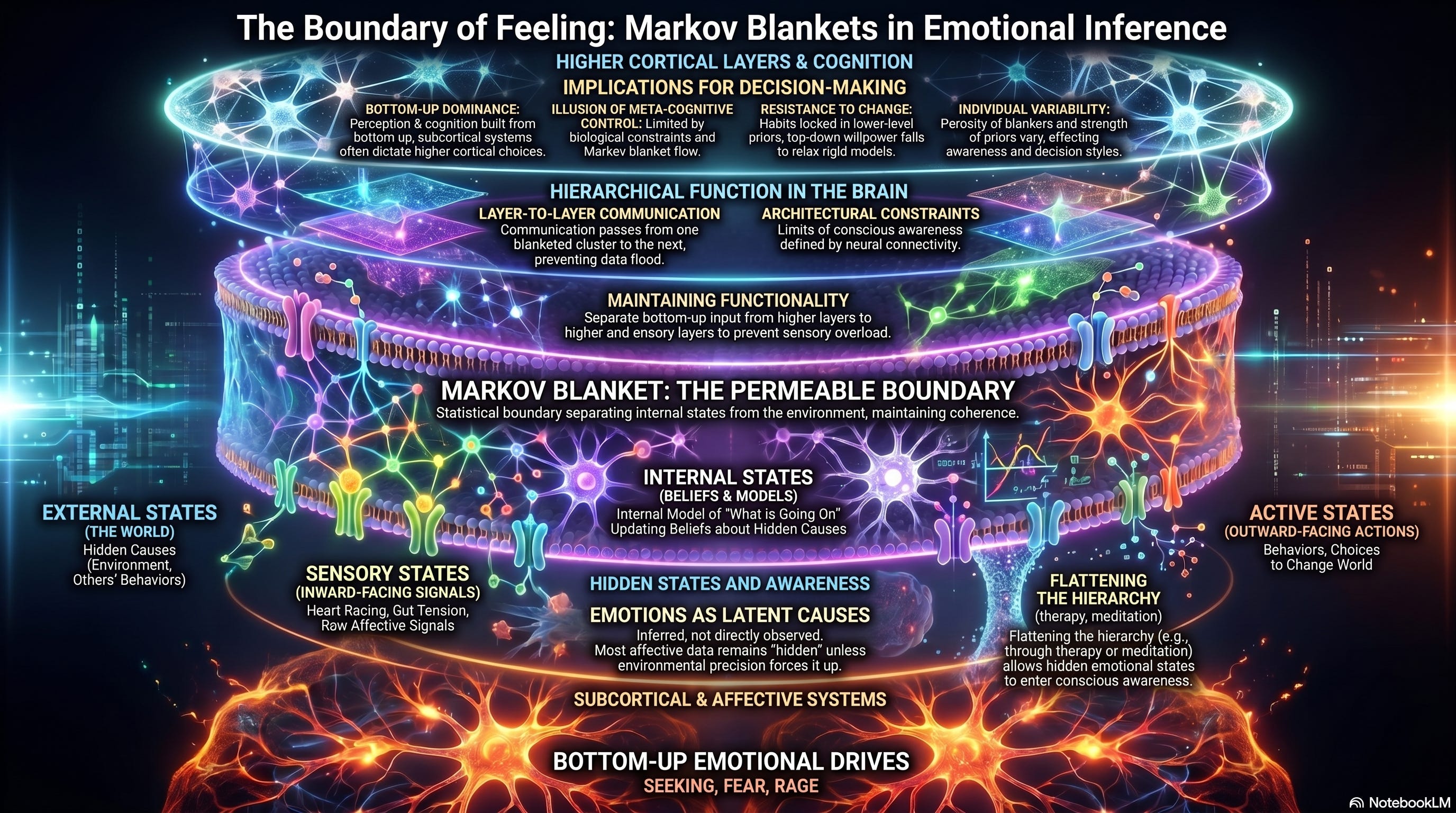
Markov blankets are what make this inference possible and what keep the system coherent. Imagine what would happen if all that information and sensory information got pushed into the higher cortical layers, and your awareness and direct intentional control, it would be maddening. Each one of these clusters, or areas, are all confined or constrained by the architecture of the neurons and how far these extend and their ability to project. And by which area connects to which are, through which circuitry. A way to visualize or conceptualize of the blanket is as a permeable but insulating boundary. This extends to you as a singular unit, since it forms the boundary around “you”. The function thereof mimics the way this boundary happens in a cell, in terms of the cell having receptors on the cell wall that signal to the inside of the cell, and where appropriate, allows things to pass through the cell wall. So if we extend this line of thinking, using the computational terminology:
External states = the world (including other people).
Sensory states = the blanket’s “inward-facing” side (what you actually detect: heart racing, gut tension, facial feedback, etc.).
Active states = the blanket’s “outward-facing” side (your actions, choices, behaviors that change the world).
Internal states = your beliefs/models about hidden states (what’s really going on emotionally and in the world).
Hence, the word inference, we are inferring what is happening externally, and attempting to act on it. The complexity of human beings is that there is so much bottom-up information and input, that this has to be separated from our higher cortical layers so we can be functional in moving, acting and responding in the outside world. Hence, we also have to infer this internal input and information. And thus we have effectively set the stage for what these hidden states are, since a lot of that information, regardless of its origin, is hidden from us, UNLESS the need for the information to flow up the hierarchy changes, OR when we intentionally (or perhaps unintentionally) flatten this hierarchy. This then also forms a significant stumbling block in terms of decision-making and changing habits. Since so much of it flies under the radar for a host of reasons.
One of these reasons is because of the emphasis and focus on cognition and meta-cognition in decision-making, as if they are the end-all, be-all, without their constraints or limitations, or a quasi metaphysical capacity to circumvent all biology. The latter idea is laughable at worst, and highly concerning at best. Since most of your decision-making, perception, and cognition is built from the bottom up, that obviously dictates what happens in the higher cortical layers. And most importantly, that the flow of information from the top down (through this hierarchy of Markov blankets) to the bottom is limited (and there is individual variability in this, even more so state-dependent per person). So then what are the parameters and mechanisms of these hidden states?
The Affect Inference Matrix
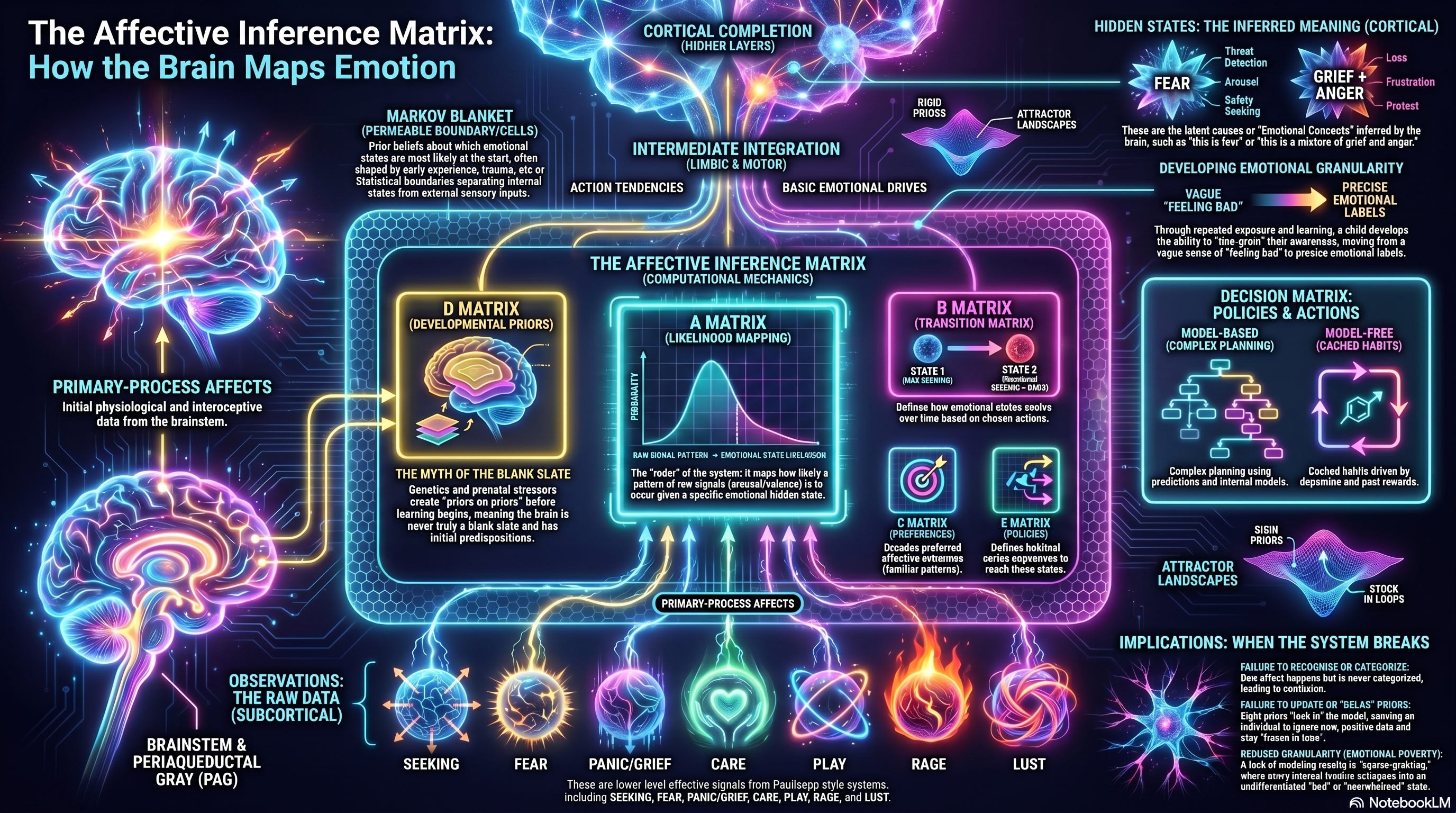
I referenced the paper Simulating Emotions: An Active Inference Model of Emotional State Inference and Emotion Concept Learning by Ryan Smith, Thomas Parr, and Karl Friston, as it formalizes exactly this. In their active inference simulations. Lower-level affective responses (raw valence, arousal, autonomic signals, tied to Panksepp-style systems like SEEKING, FEAR, PANIC/GRIEF, CARE, PLAY, RAGE, LUST) are the observations. Whereas Emotional concepts such as: “this is fear,” “this is a mixture of grief and anger,” “this is anxious excitement”, are the hidden states the model infers. In the paper, the model starts with “blank” hidden states, meaning there was no content, and the model learns to carve the affective data into distinct emotion concepts through repeated exposure, exactly” like a child learning emotional granularity. Although they make a case that in a child, you already have priors because genes, epigenetics, prenatal and natal exposures, so although they still need to learn emotional concepts, and this carving will happen, there is a significant amount of variance here.
As an example of this, if the mom is highly stressed during pregnancy, the child gets flooded with cortisol, which will alter what is forming in his brain, and speak to certain expression or silencing of genes, as such, there are priors on priors. They can’t really account for that since this is computationally beyond the scope of what they can do, so we need to account for the fact that there is technically very little “blank slate-ism”. This doesn’t change the fact that emotional concept learning takes place in the way that it does, what it does change is that the carving already occurred, and this is an attractor (state and landscape) that is formed as a prior. This doesn’t mean all is doomed or there is no hope, there’s usually plenty of plasticity to go around, it just means the priors can be very rigid and heavy. Regardless, with all of that being said, let’s map the matrix that they use to outline the various responses or “experiences”.
Initially, the authors model emotional state inference and concept learning as a partially observable Markov decision process (POMDP) under active inference.
Observations (o): Raw, lower-level affective signals that are all the interoceptive, autonomic, valence/arousal patterns “data” from subcortical systems.
Hidden states (s): Higher-level emotional concepts, the inferred categories, such as “fear”, “frustrated SEEKING”, “grief”, or more granular mixtures. These are what the brain must learn and infer to explain the raw affective observations.
The model starts with relatively “blank” or coarse hidden states and learns to carve the affective data into distinct emotion concepts through repeated exposure (minus the prior’s priors we just talked about).
The Key Matrices (Standard Active Inference Notation)
The generative model is defined by these probabilistic matrices (we’re going to map and explore these fully later, it’s just a breakdown as a stage setter:
A matrix (Likelihood mapping):
This is the heart of emotional state inference. It encodes P(observations | hidden states), how likely a particular pattern of raw affective signals (valence, arousal, autonomic changes) is under each emotional concept (hidden state). This is the “radar” that maps raw Panksepp-system activity (SEEKING, FEAR, PANIC/GRIEF, CARE, PLAY, RAGE, etc.) onto inferred emotional concepts. Early in learning, the A matrix is coarse or noisy and with experience, it becomes more precise and differentiated.B matrix (Transition matrix):
Encodes P(next hidden state | current hidden state, policy), how emotional concepts evolve over time or shift under different policies (actions). This is useful for modeling state transitions such as from “mild SEEKING” to “frustrated SEEKING + RAGE” or failure to shift states. This will be important to keep in mind, since each one of these primary affects also exists on a continuum, and thus has different expressions thereof.D matrix (Prior over initial hidden states):
These are the prior beliefs about which emotional concepts are most likely at the start shaped by early experience/trauma. These are strong priors for negative affects (FEAR, PANIC/GRIEF, RAGE) from critical developmental windows (explored fully below as an adjunct to Unchosen Beliefs).C matrix (Prior preferences over outcomes):
This encodes what kinds of affective observations the agent “prefers” (preferred valence/hedonics). In other words, the system works to realize preferred (usually familiar negative or protective) affective patterns, protecting the existing hidden-state repertoire.
The E matrix for prior preferences over policies is sometimes included but is secondary in this paper. Although it is primary in Unchosen Beliefs, that’s a combination between C and E in that sense. The hidden state is the category/label the brain assigns so it knows “what to do with this feeling” (approach, avoid, soothe, explore, etc.). Without good inference or learning here (model/belief updating) one experiences:
Failure to recognize the state (it’s happening but not categorized).
Failure to listen/upgrade the model (priors lock it in).
Not knowing how to shift or ride it out (no policy for that hidden state).
Knowing the different matrix classifications doesn’t matter as much, so don’t worry about this. I will relate them properly to our experiences and behavioral patterns in the following section. The important thing to take away here is that in this framework, in light of the different fields we’re using here, emotions aren’t just “feelings”, rather, they’re inferred hidden causes that the brain uses for allostatic control (keeping the organism in viable ranges). Which is the primary function of emotion in the first place, but as a human being we experience immense complexification in these. Since it emerges from the PAG (periaducitical grey), moves further up in the brain stem, then up through the limbic and motor cortex and finally into the higher cortical layers, which allows for this complexification, range, and scope. This is, of course, still has some individual variance, which will also be a key part of The Intuitive Self. So let’s expand on the premise of these hidden states and what they mean to us.
